


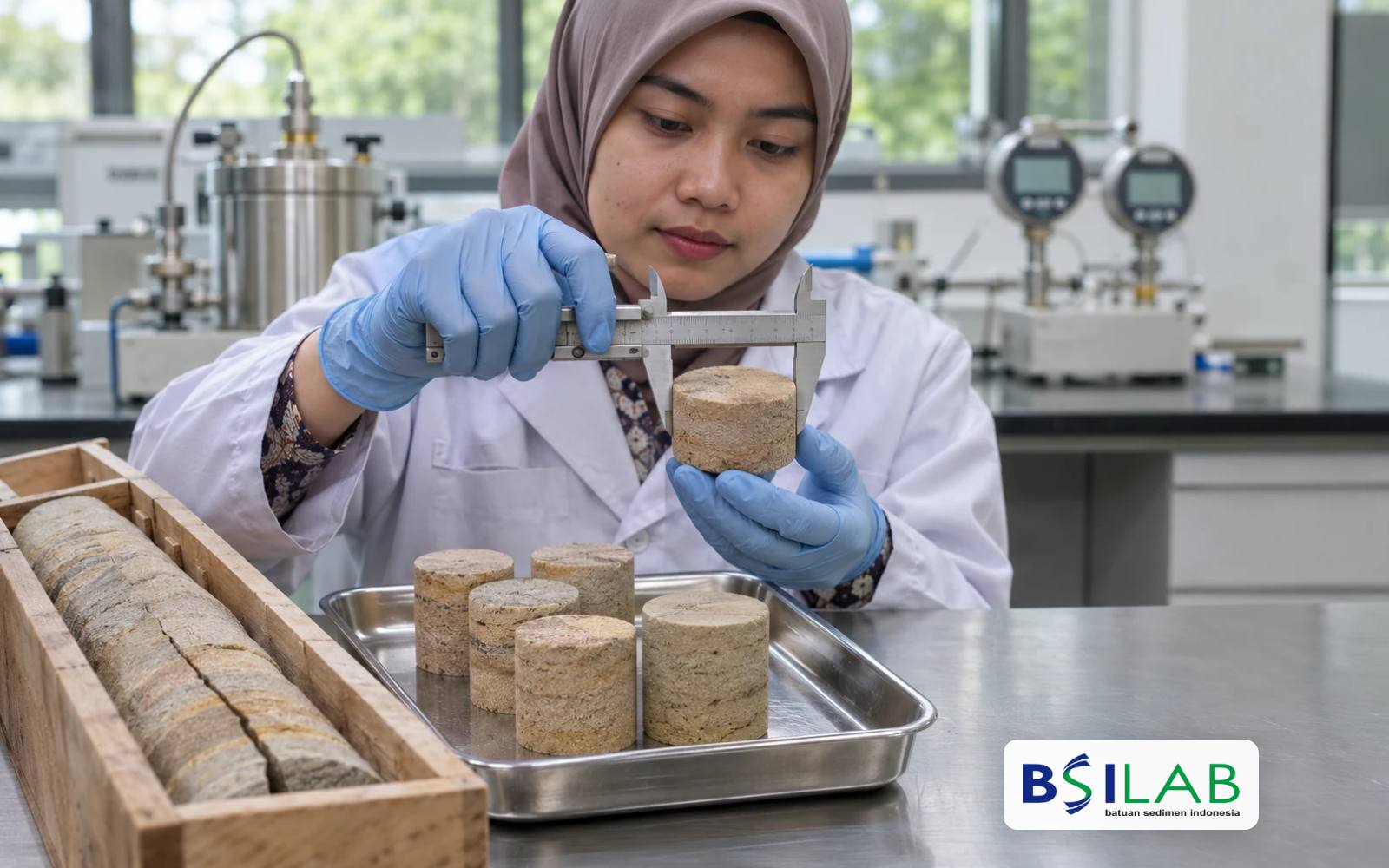
Routine core analysis (RCA or RCAL) is a series of basic lab tests on core samples of rock to measure porosities, permeability, grain density, and fluid saturation. The data is the foundation of the reservoir assessment of oil, gas and hot earth: how many fluids can be stored in rock, and how easily it flows into the well. His test practice refers to RP 40 API (Recommended Practice for Core Analysis).
- Porosities = volume of pores a total volume of rock × 100%.
- Permeability measures the flow of fluida, its dividability.
- Measurement done on plug The cores have been cleaned and drained.
- RCA results are used for rock typing, log calibration, and selecting SCAL samples.
What is measured in routine core analysis?
| Parameter | Meaning | General method | Units |
|---|---|---|---|
| Poropity | The volume part of the rock that represents porous space | helium porosimeter (Boyle law) + volume bucket | % (fraction) |
| Permeability | The ease of fluid flows through interconnected pores | Gas flow (nitrogen / air) by Darcy law, corrected by Clerkenberg | mD |
| item density | Mass mineral pellets per volume of items | Dry weight using the volume item (from porosimeter) | g / cm © |
| Fluid saturation | The proportion of pores filled with water and oil | Default | % pore volume |
RCA line in lab
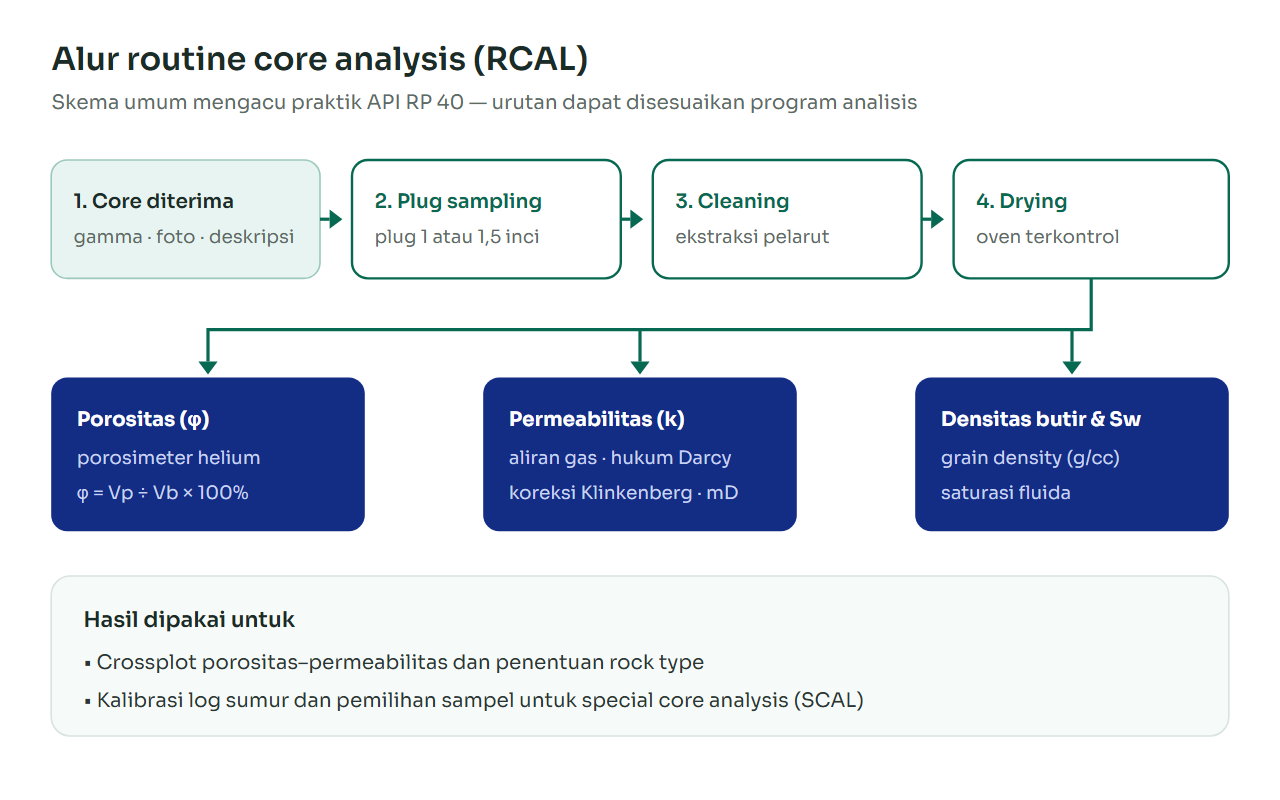
- Acceptance and core documentation — The core measured its depth, scanned gamma (core gamma) to match log wells, photographed, and described its lithology.
- Plug fetch — Small cylinders (generally 1 or 1.5 inches in diameter) drilled from the core, usually horizontal (parallel layers) and some vertical to see the permeability erosropy.
- Cleaning — Remaining oil, water formation, and salt released with solvent extraction. At this stage, fluid saturation can be measured by the Dean- Stark method.
- Dry — Dragged plug in the oven. The clay-rich rock should be drained at controlled temperature and moisture so that the water tied to the clay doesn't go away and the porocity is not read too high.
- Measurement — porosities, permeability, and grain density are measured on the same plug.
Poroities formula and computation samples.
Poroities is the ratio of pores (Vp) against total volume or volume bulk of rock (Vb):
Sample: A plug has a volume bubble of 20.0 cm. The helium porosimeter measures its bouncy volume by 16.2 cm. So the volume of the pores is equal to 20.0. 16.2 is equal to 3.8 cm, and the portals are equal to 3.8. 20.0 is 100%. 19%.
helium porosimeters are used because helium molecules are so small that they don't react to minerals, so they can get into smooth pores that are connected. The result is effective porosities (connected pore). Total poroities also calculate isolated pores, and usually only can be obtained by destroying samples.
Permeability and Clerkenberg correction
Permeasibility calculated from Darcy's law.: the rate of fluid alides through samples is equal to the permeasibility, the vastness of the graft, and the difference in pressure, as well as the opposite of the viscosity of the fluid and the length of the sample. In the lab, regular measurements use gas because it's fast and doesn't damage samples.
The problem is, in the narrow pores the molecule of the gas "slips" on the pores so that the permeability of the gas is read higher Instead of permeability to fluid. This effect is corrected by Clerkenberg correction (Clerkenberg, 1941). The lower the permeability of the rock, the bigger the difference, so this correction is essential to strict rock.
How to read porosities and permeability
The following classification is summarised from general classification (Levorsen, 1967; North, 1985) and is often used as an early qualitative guide for the sandstone reservoir. The real limit of reservoir is highly dependent on fluid, pressure, and field economy.
| Quality | Poroities (%) | Permeability (mD) |
|---|---|---|
| Very low | < 5 | < 1 |
| Low | 5–10 | 1–15 |
| Medium | 10–15 | 15–50 |
| Good | 15–20 | 50–250 |
| Very good | 20–25 | 250–1.000 |
| Special | > 25 | > 1.000 |
Poroities and permeasibility data are usually plotted in crossplot (logarithmic scale permeability to porosities). The dot group with the same trend shows rock type Different. From here the reservoir engineer makes an equation to estimate the permeasibility of the porosities log in the non-core interval.
Quality check item density
The density of the grain helps check the consistency of the data and show the dominant minerology. As a reference, the density of quartz is about 2.65 g / cm, calsite 2.71 g / cm, and dolomit 2.87 g / cm. Remote deviant values can signify heavy minerals (e.g. pirites), remaining salt, or unresolved cleaning.
RCA, SCAL, and other analysis complete
RCA is done on many samples. The results are used to select samples representing each rock type, and then the selected sample goes to Special core analysis (SCAL) to measure capillary pressure, relative permeasibility, and validity. Petrographic analysis on a thin incision helps explain why A porous sample is good or bad,
Need porosities and permeability for a reservoir study?
Discuss the routine core analysis program, plug number, and support analysis with the BSILAB team.
Questions often asked
What's a routine core analysis?
Routine core analysis is a basic laboratory test on core samples to measure porosities, permeability, grain density, and saturation fluid. The results were used to assess the quality of the reservoir, create rock type, calibrate the well log, and select samples for special core analysis.
How's the porocity formula for rock?
Poroities equals pores over volume bulk of rock times 100 percent. The porous volume obtained from the volume of the bucket minus the volume of the item. Let's say the volume is 20 centimeters, and the volume is 16.2 centimeters, so it's 19 percent.
Is that an RP 40 API?
The RP 40 API is the Recommended Practice for Core Analysis of the American Petroleum Institute. This document is a reference to the treatment of cores, cleaning, drying, and porosities measurement, permeability, as well as the fluida saturation for interlaboratory data to compare.
Why should the gas permeability be corrected by Clerkenberg?
In narrow pores, the molecules of the gas slip across the pores so the permeability of the gas is read higher than the permeability of the fluid. Clerkenberg corrects this effect, and the impact is getting bigger on low permeasibility rocks.
What is the difference between effective porosities and total poroities?
Effective portals only calculate the interconnected pores and can be flowing fluida, for example measured by helium porosimeter. The total shaft also covers isolated pores and water bound to clay minerals.
American Petroleum Institute (1998). API RP 40:, 2nd ed. · McPhee, C., Reed, J. & Zubizarreta, I. (2015). Core Analysis: A Best Practice Guide. Elsevier. · Clerkenberg, L.J. (1941). The Permeability of Porous Media to Liquids and Goses. API Drilling and Production Practice. · Levorsen, A.I. (1967). Geology of Petroleum. · North, F.K. (1985). Petroleum Geology.

