


Chromatography (GC) and Chromatography Gas (GC-MS) Separating and identifying molecules of hydrocarbons in oil or extracting rocks. From this molecule's fingerprint.—Especially biomarker—ahli geokimia dapat menelusuri asal minyak, lingkungan pengendapan batuan induknya, tingkat kematangan, hingga tingkat biodegradasi. BSILAB menyediakan rangkaian analisis ini mulai dari ekstraksi bahan organik, pemisahan fraksi, GC, hingga GC-MS. Analisis GC, GC-MS, ekstraksi, dan SARA dikerjakan in-house di laboratorium geokimia BSILAB.
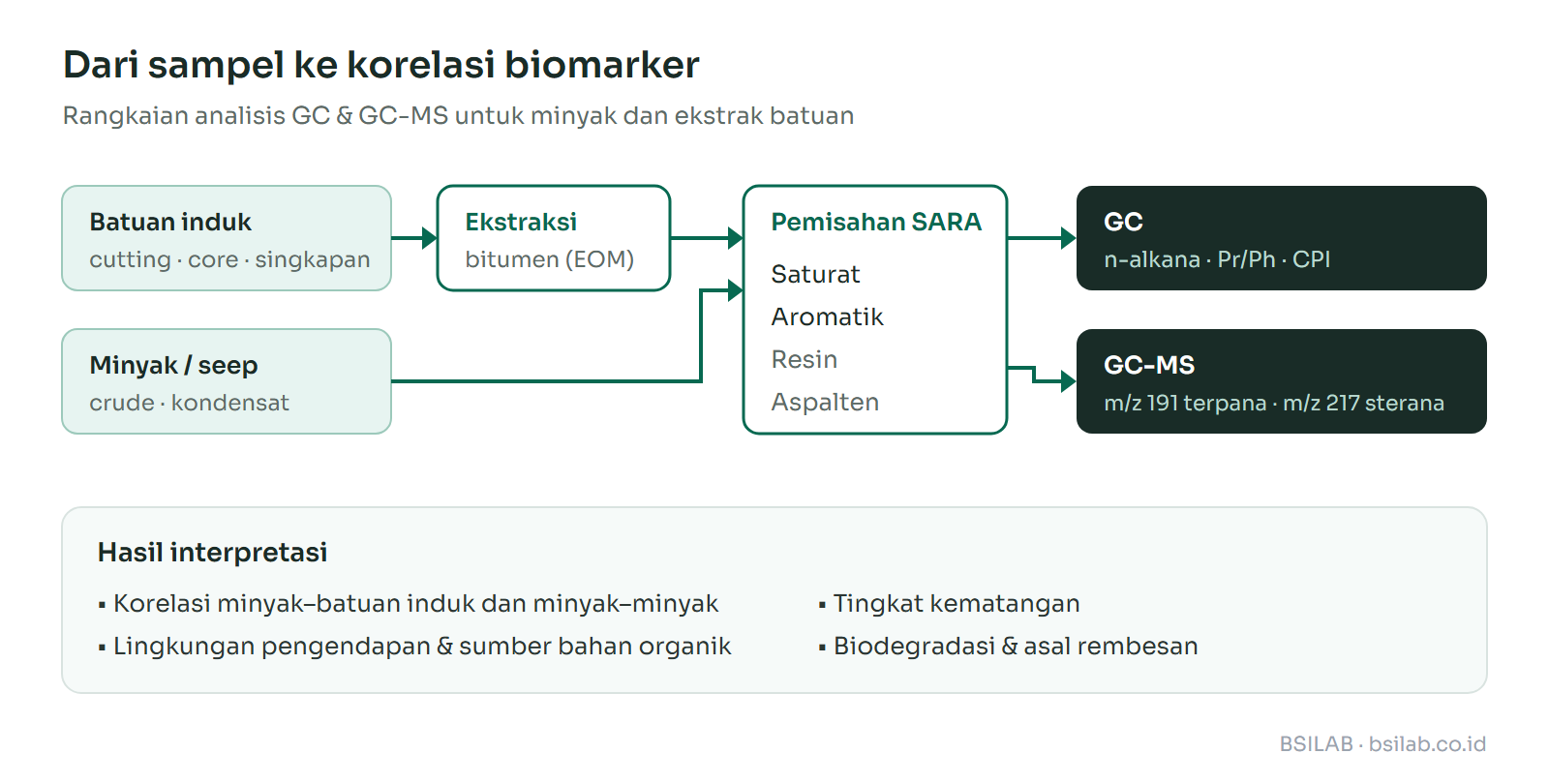
Analytic sequence
- Extraction of concentrated organic material (EOM) — For rock samples, the bituses were extracted with organic solvent.
- Pemisahan fraksi (Liquid Chromatography / SARA) — Extractions or oil separated into parts of saturate, aromatic, resin, and asphalt.
- GC whole oil / extract — distribution profiles and isoprenoid.
- GC-MS — Biomarker identification of saturate and aromatic fractions, particularly floored (m / z 191) and sterana (m / z 217).
- Carbon isotopes The saturate and aromatic fractions as correlation support data.

What can GC & GC-MS answer?
| Question | Data to use |
|---|---|
| This oil is from which mother rock? (oil correlation - parent rocks) | sterana & floored patterns, biomarker ratio, carbon isotope |
| Is the oil in two wells from the same source? (oil correlation) | GC fingerprints and biomarker |
| How's the holding of the mother rock? | Pr / Ph, C sterana distribution27-C28-C29, gammacerane |
| Are there contributions to flowering land plants? | Oleanane |
| How mature is the oil or the extremes? | Ts / Tm, isomerization sterana C29 20S / (20S + 20R) |
| Is the oil biodegraded? | Missing is relative to isoprenoid, showing 25-norhopana. |
| The origin of oil oil or oil spill | Biomarker fingerprint compared to reference sample |
Parameters are generally reported
| Parameter | Data source | General indications |
|---|---|---|
| Pristana / Fitana (Pr / Ph) | GC | Low value ( 3) tends to have land organic material in an octical state |
| Pr / n-C17, Ph / n-C18 | GC | Stability, environment, and biodegradation |
| CPI (Carbon Preference Index) | GC | The value far above 1 shows the contribution of land plants and / or low maturity |
| Ts / Tm | GC-MS m / z 191 | Wealth (also affected lithology) |
| Sterana C29 20S / (20S + 20R) | GC-MS m / z 217 | Wealth; approaching equilibrium 0.52-0.55 |
| Distribution of sterana C27-C28-C29 | GC-MS m / z 217 | The source of organic material: sea algae versus land plants |
| Oleanane Index | GC-MS m / z 191 | Flowery Crop Contributions (Permanently the Akur-Tersier Chalk) |
| Gammacerane index | GC-MS m / z 191 | Straighten high water / collarity columns |
Indications parameters follow Peters, Walters & Moldowan (2005), The Biomarker Guide. Each ratio can be affected by several factors at once, so interpretation always uses a combination of parameters, not one number.
Analyable sample
- Raw oil and condensate from a production well or test the content of layers.
- Extract of parent rock from cutting, core, mental, or abbreviation.
- Oil drops on the surface.
Requires a different number of samples for oil and rock. The BSILAB team will inform him when they consult.
Need an oil-mother correlation?
Tell me the purpose of your study—correlation, detachment environment, or seething origin.—And the BSILAB team will set up a proper series of analysis.
Questions often asked
What's the difference between GC and GC-MS?
GC separates the hydrocarbon compound based on its exit time from the column and displays its profile. GC-MS added a mass spectrometer so each compound could be identified from its fragment pattern. Biomarker is like sterana and homana can only be read well using GC-MS.
What's a biomarker in oil geochemistry?
Biomarker is a fossil molecule in oil or a rock whose structure still reflects the origin of organisms, for example, a sterana of algae and a homapana of bacteria. The pattern was used as a fingerprint to track the origin of oil, the detachment environment, and the level of rigidity.
What is m / z 191 and m / z 217?
Both are ion fragments being monitored on GC-MS. Ion m / z 191 featuring floored groups like hopane, tricyclic floored, oleanane, and gammacerane. Ion m / z 217 display sterana. These two chromatograms are the main correlation of oil and parent rock.
Can GC-MS be used to track the source of the spill or oil seething?
I can. The fingerprints of a biomarker an oil relative to light layover, so it can be compared to a sample of the reference of a well or a suspected source. The results help determine whether two possible samples are from the same source.
Peters, K.E., Walters, C.C. & Moldowan, J.M. (2005). The Biomarker Guide, the 2nd edition. Cambridge University Press.


