


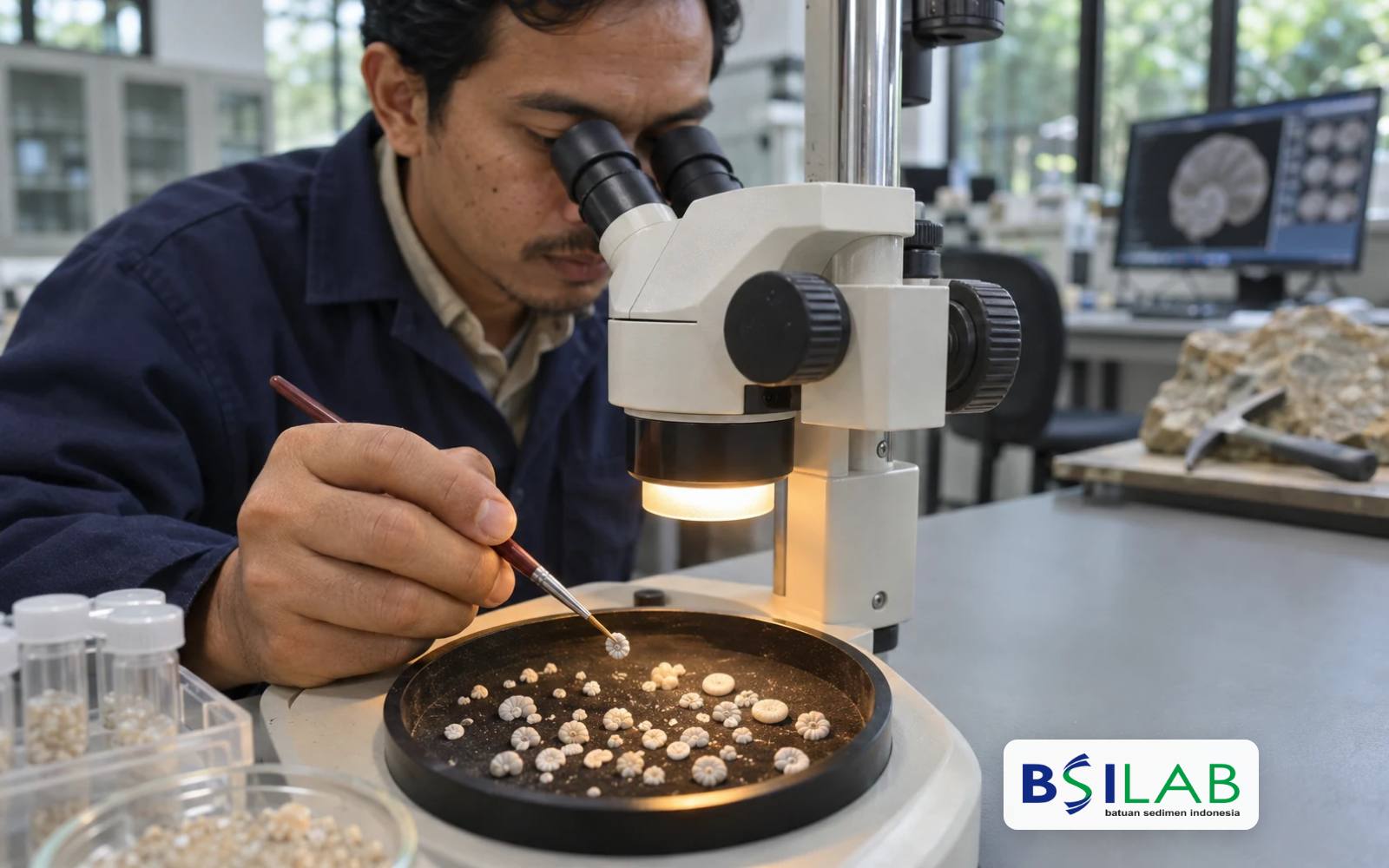
Sedimentary most often defined by biostratigraphy: read the micro fossils contained in it, especially foraminifera and gay nannofossil. Every species lives within a certain geological time span. By looking at any species that comes together in one sample, biostratigraphy experts can put the rock into a pretty narrow age zone, even up to hundreds of thousands of years.
- Biostratigraphy gives relative age Based on the emergence and extinction of fossil species.
- Foraminifera plankton and nannofossils are most commonly used for the age of Tersier sea rocks.
- Foraminifera bentos is used to interpret the environment and the depth of detection.
- On cutting samples, the trusted ones are Top appearance Fossil due to the collapse contamination.
relative age vs absolute age
Absolute Age It was stated in years, for example million years ago (Ma), and usually obtained from radiometric dating on frozen rocks or volcanic ash. Relative age specified sequence: which layer is older or younger. Biostratigraphy produces relative life in form zone, such as the N9 or NN5 zone.
The principle: overlap species living range
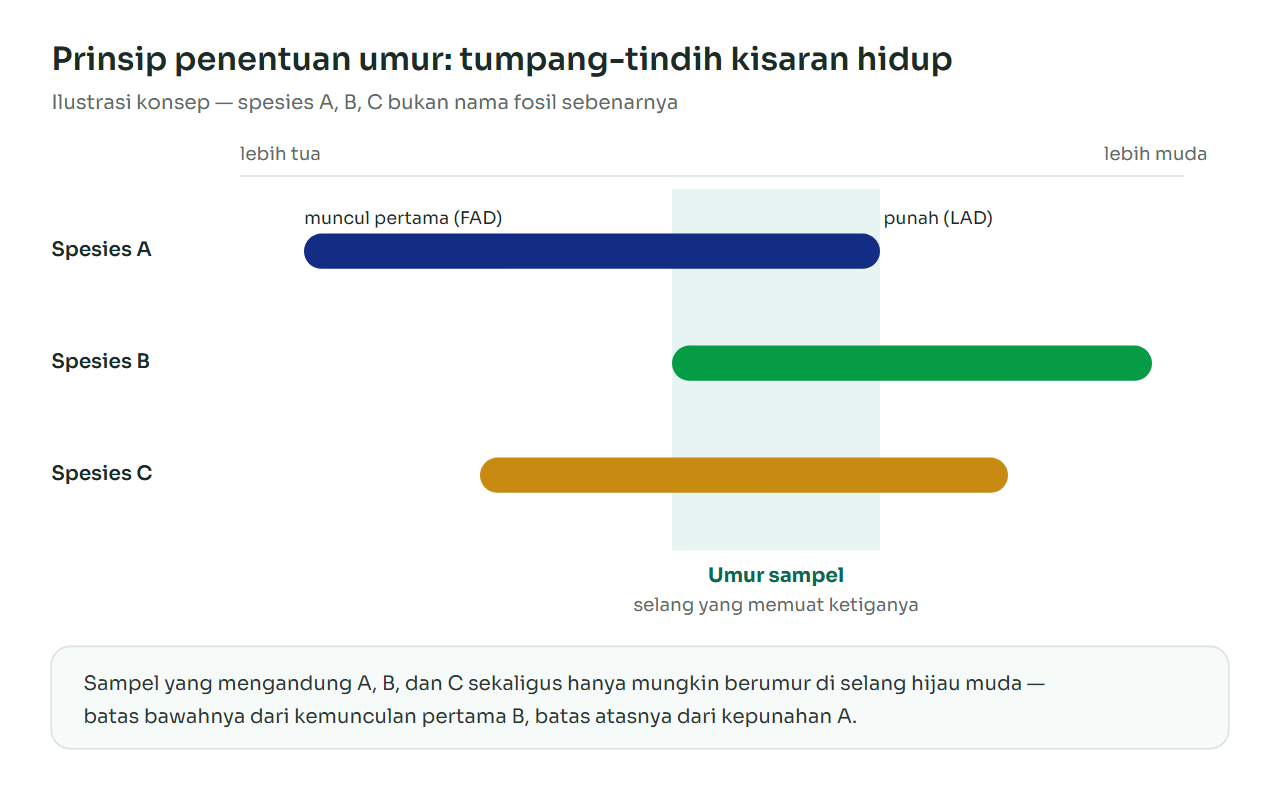
Each species has two crucial points in its history: first appearance (first appeal datum, FAD) and extinction (last appeal datum, LD). If a sample contains multiple species at the same time, it must be in the hose when the range of all species's survival is overlap. The more species of pointer is recognized, the smaller the age hose is.
One of the famous markers is the first appearance of the plankton foraminifera. Orbulina universa, which marks the base of the N9 Blow Zone in Central Miosen, about 15 million years ago.
Foraminifera, nannofossils, and palinology: what's the difference?
| Fossil group | Size & observations | Most useful for | Common zone scheme |
|---|---|---|---|
| Foraminifera plankton | 0.1 -1 mm, binary microscope | Age of sea rocks | Blow zone N / P; Wade dock. (2011) |
| Foraminifera bentos | 0.1 -2 mm, binary microscope | Environment and detachment depth | Fauna association |
| Nannofossil gajil | < 30 arkum, a polarized microscope of order Rs.1000 × | High-resolution age, just need a little sample | Martini (1971) NN / NP zone; Okada & Bubry (1980) |
| Palinology (polen & spore) | Rs.@@ | Ground rocks and transitions of poor sea fossils | Regional Zoning |
Step determines the age of rock with foraminifera
- Sample retrieval — Take a nice, fresh rock. Rude sand and rock are usually poor fossils.
- Preparation — The sample was slowly destroyed, soaked (for example with hydrogen solution peroxide) to decompose, then washed over a delicate filter.
- Election (picking) — The residue is drained, and then fossils are taken one by one under a binary microscope.
- Identification — The species is recognized from the shape of a shell, the layout of the room, and the array.
- Zone Enhancement — The presence of the pointer species matched with the zoning scheme, then determined the zone and estimated age.
- Tapping environment — The foraminifera bentos association and the ratio of plankton to bentos is used to interpret whether rocks are dipped in shallow seas or deep seas.
A lot of traps.
- The caving in the cutting sample — When drilling, the fragments from the upper layer can fall and mix into the samples below. Therefore, on cutting which is Top appearance A species when read from top to bottom, not its first appearance.
- Remodel fossil (returned) — Older fossils eroded and recycled in younger rocks can make the age too old.
- Non-fossil sample — Ground rocks, rough sand rocks, or dissolved rocks often don't contain foraminifera. In this case, palinology is an alternative.
Need to determine the age and environment of rock detection?
Consult your abbreviation, cutting, or core samples for foraminifera, nannofossils, and palinology analysis.
Questions often asked
How do I determine the age of rock with foraminifera?
The rock samples were preparated and washed, and then the foraminifera fossils were taken and identified under a microscope. The presence of the pointer species matches the zoning scheme like Blow (1969). The age of rock is in a time lapse when all the species found alive together.
What's the difference between foraminifera plankton and bentos in biostratigraphy?
Foraminifera plankton lives floating in the water column and spreading widely, so it's suitable to determine age. Foraminifera bentos lives at the bottom of the ocean and is sensitive to depth and marine conditions, so that it is used to interpret the detachment environment.
Why do nanopathy often wear to the age of rocks?
Nannofossils are evolved rapidly, abundant, and require very little samples to analyze. This makes it very useful to determine the age by high resolution, including on small cutting samples.
Can any of these rocks be determined by the age of fossils?
No. Frozen rocks, metamorphous rocks, and a lot of ground rocks don't contain sea fossils. Ground sediment can be analyzed with palinology, whereas frozen rock usually requires a radiometric dating.
What's the N zone in biostratigraphy?
Zone N is a grotesque zoning scheme for a plankton for Neogen that is set up Blow (1969), from N4 in Miosen to N23 at the Holocaust. The scheme is still widely used in Indonesia, next to the newer zoning.
Blow, W.H. (1969). Late Middle Eocene to Recent Planktonic Foraminiferal Biostratigraphy. First Inn, Conf, Planktonic Microphossils.. · Martini, E. Standard Tertiary and Quaternary Calcareous Nannoplankton Zonation. · Wade, B.S. Dkk. Review and Revision of Cenozoic Tropical Plantonic foraminiferal biostratigraphy. Earth-Science Review 104. · BouDagher@@ Biostratigraphic and Geological Signature of Planktonic Foraminifera. UCL Press.
