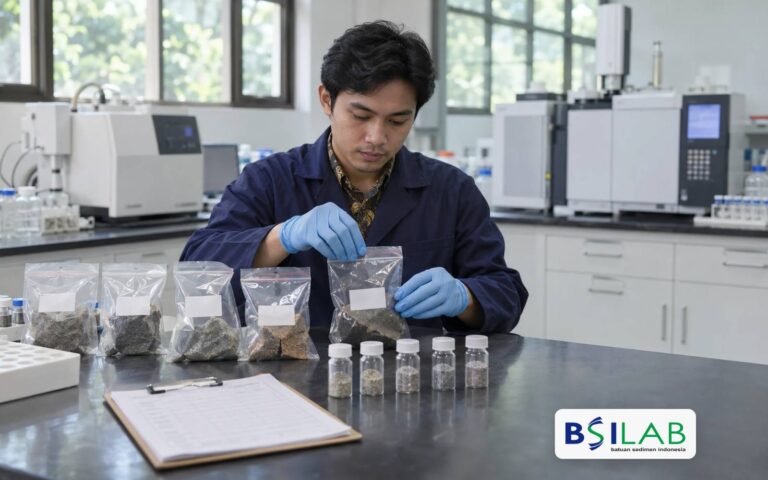
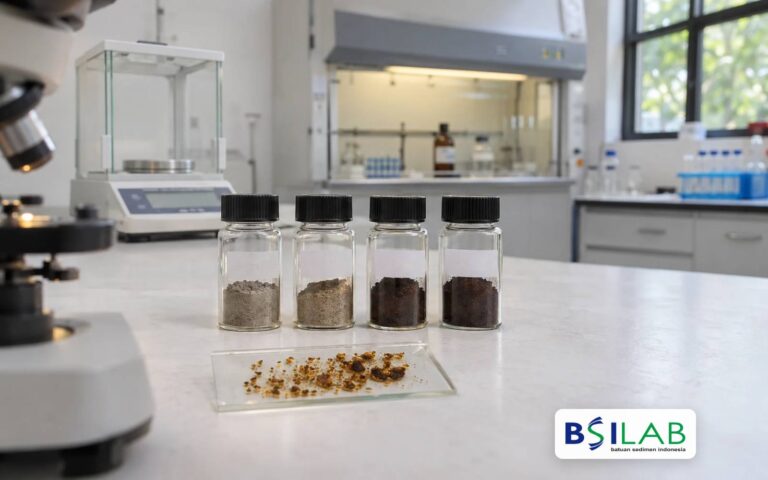
TOC (Total Organic Carbon) is the amount of carbon that comes from organic matter in the rock, otherwise in a heavy percent. In the exploration of oil and gas, TOC became the first number the geologist saw to judge whether a rock was ever rich enough organic to be parent rocks. This article talks about the definition of TOC, the origin of the organic carbon in the rock, the way it curses, how to read the results, and the most common interpretation mistakes.
TOC understanding in oil geology
The sediment rocks contain two types of carbon:
- Inorganic carbon (TIC) — Especially in carbonate minerals such as calcite and dolomite.
- organic carbon (TOC) — organisms like algae, plankton, bacteria, and land plants are preserved with sediment.
The second number is called total carbon (TC)It's this organic carbon that, after being buried deep and heated for millions of years, turns into Kerogen Then produce oil and gas.
Why are there rocks that are rich in organic carbon?
Organic matter can only be preserved if it doesn't unravel. The three most decisive factors:
- High organic productivity — For example, the Nithrien-rich waters, lakes with algae blasts, or delta that receive a lot of plant material.
- Poor condition of oxygen (anoxic) — At the bottom of an uncalculated lake or ocean, the dismantling bacteria work slowly.
- Matching semmentation rate — Fast enough to stockpile organic material, but not too fast so organic material is diluted by other materials.
Because it's shale and clay is dark, napal, and coal tends to have a high TOC, and clean sand rock is usually very low.
How is TOC measured in the lab?
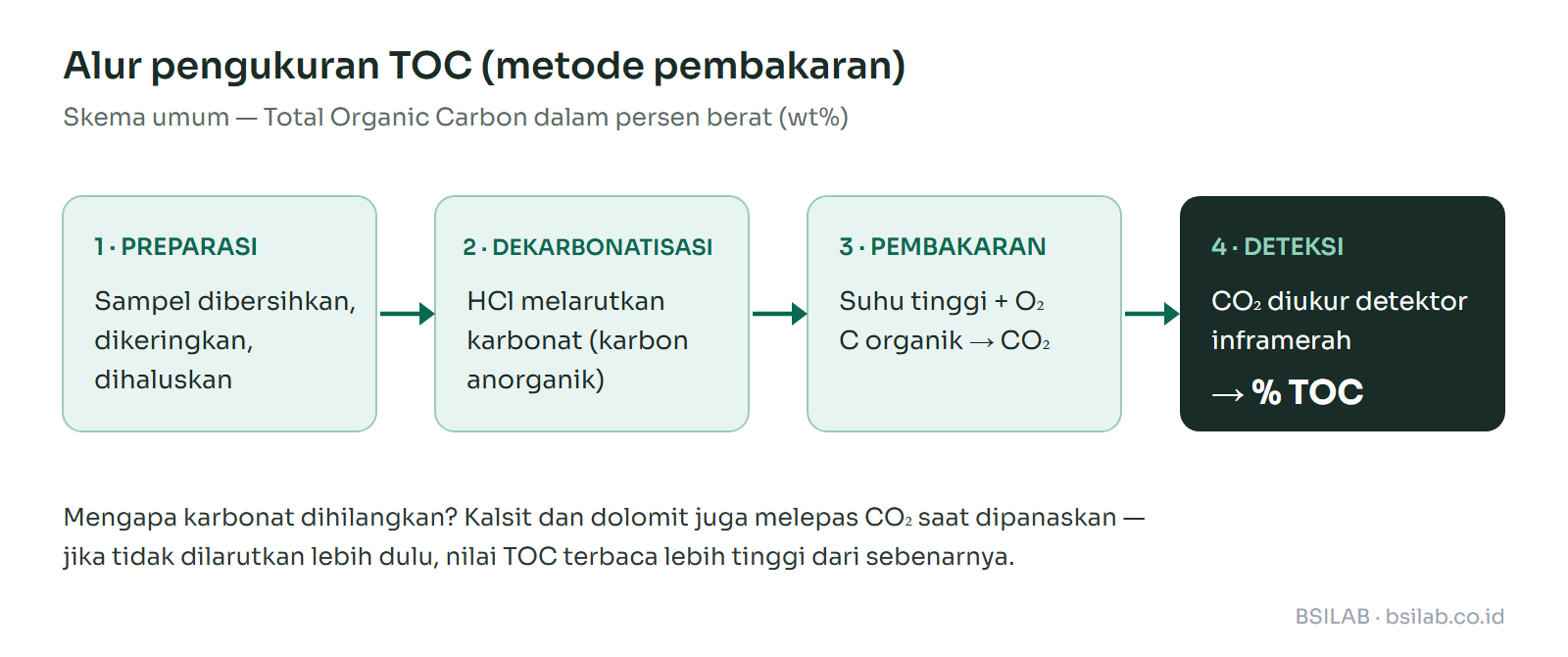
The most common method is burning. Samples are smooth, carbon is dissolved with hydrochloric acid, and then the rest are burned at high temperatures in the oxygen stream. organic carbon turned into a CO.2 And the amount is measured by detectors, generally infrared. Other methods compute TOC from the result of the new rolysis of RockEval, which burns sample residue after pyrolysis.
How to read TOC value
The most commonly used program for shale rocks is the Peters & Cassa (1994) classification:
| TOC (wt%) | Quality of parent rock |
|---|---|
| < 0,5 | Bad |
| 0,5 – 1 | Medium |
| 1 – 2 | Good |
| 2 – 4 | Very good |
| > 4 | Special |
On coal and coal flakes, TOC can reach tens of percent. Those high numbers don't automatically mean big oil potential, because organic soil plants tend to produce gas. Here it is Rock-Eval Pyrolysis It needs to see the type of crouching.
TOC today vs TOC start
When the mother rocks mature and produce hydrocarbons, some of the organic carbon goes with the oil and gas that's formed. As a result, a very mature parent rock could have a TOC lower It's more than the first time. The geologists call this the difference between Current TOC (present-day TOC) and Start TOC (original TOC). So, TOC is on a very mature rock that doesn't necessarily mean it was poor organic material.
Most common interpretation error
| Problem | Results | How to anticipate |
|---|---|---|
| It's mixed with oil-based drilling mud or organic additive | TOC reads too high | Wash samples, note mud type, check for S1 Rock-Eval |
| Cutting of mixed intervals (caving) | TOC value does not represent depth | Compare it to the log wells and cores if there |
| Frame sample | TOC reads too low because organic matter is oxidized | Take fresh samples from uncultivated parts |
| Carbonate not eliminated. Perfect. | TOC reads too high | Make sure decarbonatization is complete |
| Judging by the potential of only TOC | Wrong conclusion of oil potential | Always mix with Rock-Eval and rigorous data |
TOC role in geochemical analysis flow
In the study of parent rock, TOC acts as filter. Tens to hundreds of samples measured the totals first because they were relatively fast and economical. The sample with an adequate TOC then forwarded to:
- Rock-Eval Pyrolysis — Potential, type of carousel, and rigidity.
- Kerogen typing and vitrinite reflection — Prompt organic material and optic stability.
- Extraction, separation SARA, and GC-MS biomarker — The oil correlation with the mother rocks.
This incremental approach makes analysis costs more efficiently, because the expensive analysis is only run on a really promising sample.
Need a TOC analysis for your samples?
BSILAB serves TOC analysis and a series of geochemistry parent rocks for exploration and research.
Questions often asked
TOC stands for what?
The TOC stands for Total Organic Carbon, which is the amount of carbon that comes from organic matter in rocks or sediment. In geological oil, TOC is declared in the weight of a percent and is used to assess the wealth of organic material to parent rock candidates.
What's the minimum TOC value for parent rock?
For shale rocks, the value of about 0.5 wt% is often considered a bottom line of potential, and above 1 wt% is considered good. But the TOC value alone is not enough; it's a type of kerogen and rigidity level of RockEval and vitrinite reflection also determines whether the rock is really potential.
What's the difference between TOC, TIC, and TC?
TC (Total Carbon) is all over carbon in samples. TIC (Total Inorganic Carbon) is carbon from carbonate minerals like a calcyte. TOC is the difference between the two, which is carbon that comes from organic matter. In the study of parent rock, all it takes is TOC.
Why would a very mature master rock have a low TOC?
When parent rocks produce oil and gas, some of the organic carbon moves along with the hydrocarbons that are formed. As a result of today's measured TOC can be lower than the first TOC, so interpretation needs to consider the level of maturity.
Read too: Judging by Parent Stone (Rock Source) · Geochemical Analysis Choice · Kerogen Type I, II, III, and IV
Peters, K.E. & Cassa, M.R. (1994). AAPG Memoir 60, 300 / 120. · Tissot, B.P. & Welte, D.H. (1984). Petroleum Formation and Occurence, the 2nd edition. Springer.