


TOC analysis (Total Organic Carbon) measuring the weight percentage of organic carbon in sediment rock. This value is the first filter to judge whether a rock is potentially a parent rock (source rock) minyak dan gas bumi. BSILAB, laboratorium geosains di Tangerang Selatan, melayani analisis TOC untuk kebutuhan eksplorasi migas, studi cekungan, dan penelitian geologi. Analisis TOC dikerjakan in-house di laboratorium geokimia BSILAB.
When is TOC analysis required?
- Screen parent rocks — filter tens to hundreds of cutting or core samples to find an organic-rich interval.
- Select samples for advanced analysis — only samples with adequate TOC are passed on to Rock-Eval Pyrolysis and GC & GC-MS, so the cost of analysis is more efficient.
- Evaluation shale gas and non-conventional play — TOC became one of the main parameters of shale quality.
- Study basin and correlation — Maps a wide range of organic rich facilities between wells.
How is TOC measured?
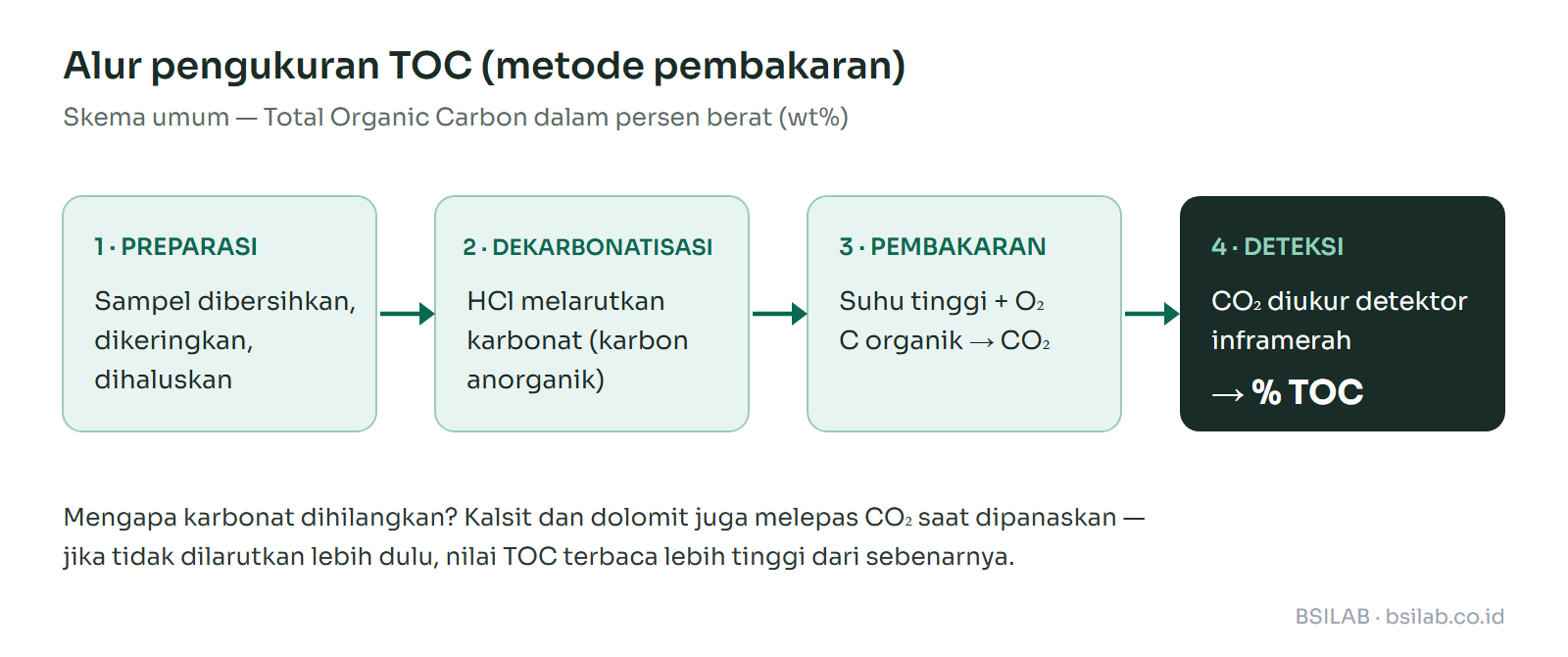
The common method in the geochemistry lab is burning (compromise):
- Preparation — The samples are cleaned, drained, then dusted.
- Decarbonatization — carbonate is removed by chloride acid, so all that's left is organic carbon.
- Burning — sample burned at high temperature in oxygen flow; organic carbon turns into CO2.
- Detect — CO count2 measured (generally with infrared detectors) and counted as a weight percent (wt%) TOC.
How to read TOC results
The following classification is the most common reference to shale rock. For carbonate rock, the threshold of potential could be lower, so interpretation should always be combined with the Rock-Eval data.
| TOC (wt%) | Potential parent rocks | The usual steps taken |
|---|---|---|
| < 0,5 | Bad (poor) | Generally not passed. |
| 0,5 – 1 | Fair | Consider Rock-Eval for key interval |
| 1 – 2 | Good (good) | Advanced RockEval |
| 2 – 4 | Very good (very good) | Advanced Rock-Eval, GC-MS candidate |
| > 4 | Excelent | Advanced Rock-Eval & GC-MS for correlation |
Classification threshold: Peters & Cassa (1994), Applied Source Rock Geochemistry, AAPG Memoir 60.
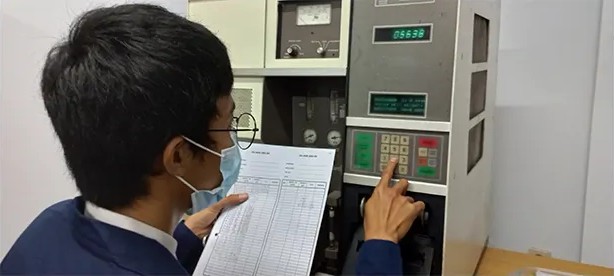
The geochemical plot of parent rock in BSILAB
| Stage | Analysis | Question answered |
|---|---|---|
| 1. Screening | TOC | Is the organic material enough? |
| 2. Potential & Stability | Rock-Eval Pyrolysis | How much is it, oil or gas, cooked or not? |
| 3. Confirm | Kerogen typing & vitrinite reflectance | Optical carogen and rigidity type |
| Four. Correlation | Ekstraksi, SARA, GC & GC-MS | This oil is from which mother rock? |
How to send samples
- Consult — Contact BSILAB team via WhatsApp or email; pass on sample number, sample type (cutting, core, simull core, or abbreviation), and target analysis.
- Sample & requisition — Our team informed us of the amount of samples required, cost, and estimate of the time of labor.
- Shipping — Pack samples per bag labeled (name well, depth, date) with sample list.
- Analysis & report — Results delivered in digital reports, ready to be combined with RockEval data and advanced analysis.
Need a TOC analysis for your project?
Consult sample numbers, analysis packages (TOC or TOC + Rock-Eval), and estimate of working time with the BSILAB team.
Questions often asked
What's a TOC analysis?
TOC analysis is a measurement of the weight of organic carbon in sediment rock. The results were used as an early filter of the potential oil and gas parent rocks, before the selected samples were passed on to the Rock- Eval Pyrolysis and advanced geochemistry analysis.
How much does a TOC think is good for parent rocks?
For shale rocks, TOC values above 1 wt% are generally considered good, 2-4 wt% very good, and above 4 wt% special. Value below 0.5 wt% is usually considered bad. A constant interpretation needs to be confirmed with the RockEval and thermal stability data.
What's the difference between TOC and RockEval Pyrolysis?
TOC just measures the amount of organic carbon. Rock-Eval Pyrolysis measures how much hydrocarbons that organic material can produce (S1, S2), which is the cranial type (HI, OI), and the level of maturity. Both are usually ordered together as screenings.
Why should carbonate be removed before the TOC measurement?
The rocks often contain carbonate minerals like a caltite that also releases CO2 when heated. If you don't remove it with acid first, this inorganic carbon is measured so the TOC value is higher than it really is.
Peters, K.E. & Cassa, M.R. (1994). Applied Source Rock Geochemistry. In Magoon & Dow (ed.), The Petroleum System — From source to trap, AAPG Memoir 60, evening. 93- 120.


