


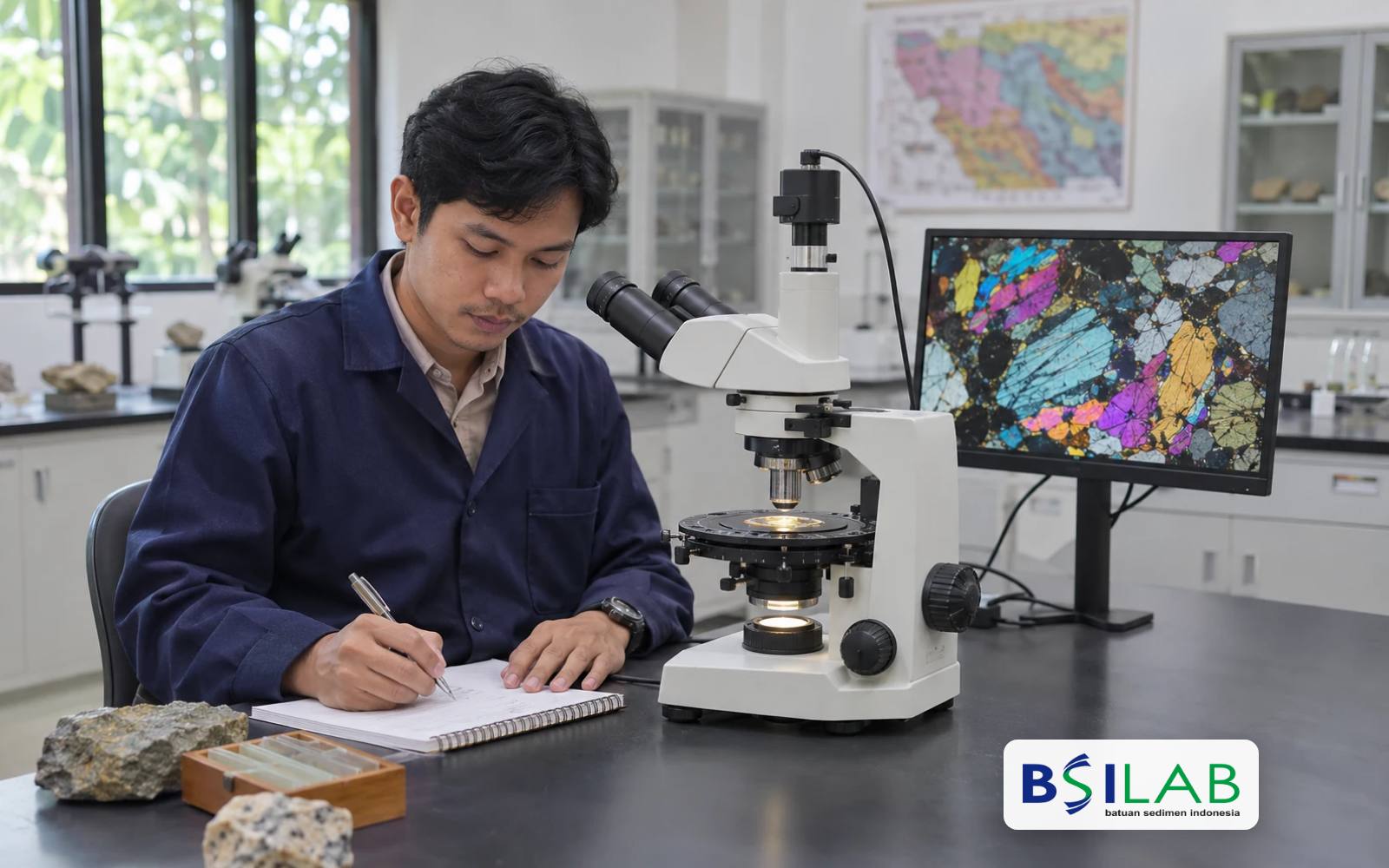
Petrography are branches of petrology that describe and classify rock based on microscopic observations, especially on Thin section It's about 30 micrometers thick under a polarized microscope. In exploration of oil, gas, and geothermal, petrography explains mineral composition, texture, pore type, and digenesis process Reservoir rocks — information that only porosities and permeability can't provide. Petrography is often equipped with XRD and SHEM.
- Thin incision: mineral composition, texture, pores, cement, and rock classification.
- XRD: mineral percentage, including the type of clay minerals that are hard to see in a microscope.
- SHEM: the pores and the autigenic minerals in very high magnification.
- All three explained why The quality of the reservoir is good or bad.
What was seen in that thin incision?
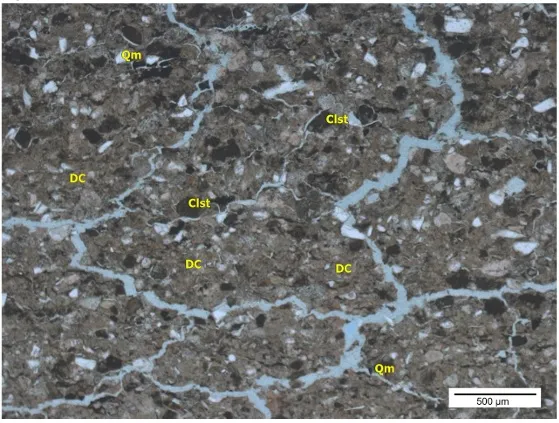
Before the incision, the reservoir samples are usually ingested. blue epoxy resin. The resin fills the connected pore, so under the microscope the pores seem blue and easily measured. The incision is then observed by the polarized light and opposite (XPL) to recognize minerals of color, relief, hemisphere and color.
Things that are described among others:
- Pattern composition — quartz, feldspar, fragments of rock, mineral carbonate, and mineral accessory.
- Texture — the size of the items, the sorting, the lying, the intermatter contact.
- Pore type — Interim pore, solvent pore, micro pore, and rupture.
- Diagenesis — Cement quartz, calendar, or dolomite, autigenic clay, solvent, and compact.
Composition usually counts with point counting, which is to calculate the type of components at grid points, generally about 300 points per incision. The results are used to classify rocks, such as Folk sandstone classification (1980) or the clutching of Dunham (1962).
XRD and SEM as complement
| Method | Principle | Main information | When needed |
|---|---|---|---|
| Thin incision | Polarized microscope, translucent light. | Composition, texture, type of pores, digenesis, classification | Almost always, as a base description |
| XRD (signal-X diffraction) | Mineral crystal diffraction pattern | Total mineral percentage and clay mineral type | Float's rich in clay; drilling and stimulation planning. |
| SHEM (electron microscope) | electron imaging, very high zoom | Autigenic clay, micro pore | The reservoir is tight and malformed. |
XRD is very important to know clay mineral type. Smektit can inflate when exposed to water with an improper combination, a caolinit can be removed and clogged in the neck of the pores, while the stringed lily can lower the perspective drastically. This information helps the engineer choose a fluid drilling and complex that's safe for formation.
Why is petrography important to the reservoir?
Two sandstones with the same porocity could have very different permeability. Petrography explains the cause: whether the pores clogged the autigenic clay, covered in quartz cement, or were precisely enlarged by the solvent of feldspar. That's why petrography is usually done together. routine core analysis to explain porosities-permeasibility trends, distinguish rock type, and select samples special core analysis.
Outside of the reservoir, petrography is also used to understand provenans, the detachment environment of stepping, and rock quality for engineering purposes.
Need a description of petrography, XRD, or SHEM?
Discuss the need for petrological analysis of core samples, cutting, or slapping you along with the BSILAB team.
Questions often asked
What's petrography?
Petrography is a branch of petrology that describes and classifies rock based on microscopic observations, especially on a thin incision of about 30 micrometers thick. The results include mineral composition, texture, pores, and the digenesis process.
What's the difference between petrography and petrology?
Ethology is a science that studies rock in general, including its origin and justification. Petrography is part of a petrology that specifically describes rock in detail, especially with a microscope.
Why is a thin incision given a blue resin?
Blue epoxy resin is injected into the pores before the rocks are cut. Underneath the microscope, pores seem blue so easily distinguished from mineral pellets, and kind and the number of pores can be observed and measured.
What does XRD do in rock analysis?
XRD or diffraction of sinar-X identify and measure the percentage of minerals in rock, including the type of clay minerals such as smectit, itt, caolinit, and chlorite. This information is important to assess the risk of formation damage during drilling and production.
When is the SHEM analysis required?
The SEM is needed when grains and pores are too small to be observed with a regular microscope, for example in strict reservoir, or when you want to see an autigenic clay mineral form that can clog the pores and lower permeability.
Folk, R.L. (1980). Astrology of Sementary Rocks. Hemphill. · Dunham, R.J. (1962). Classification of carbonate rocks according to modational texture. AAPG Memoir 1. · Ulmer-Scholle, D.S. Dkk. A Color Guide to the Petrography of Sandstones, Siltstones, Shales and Associated Rocks. AAPG Memoir 109.