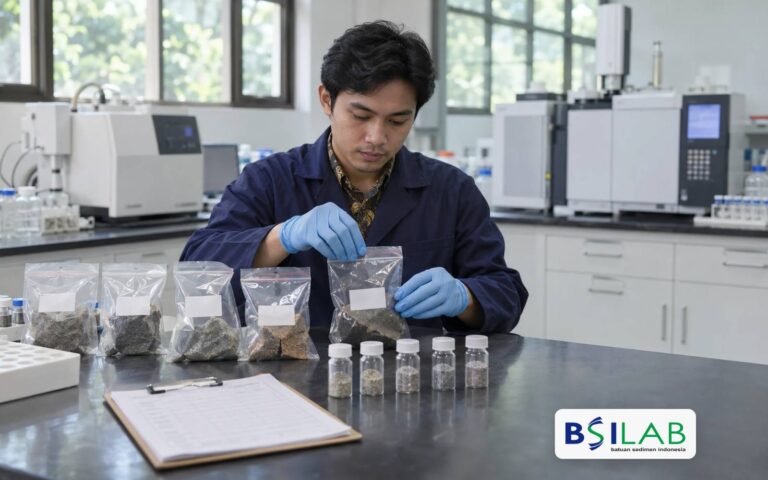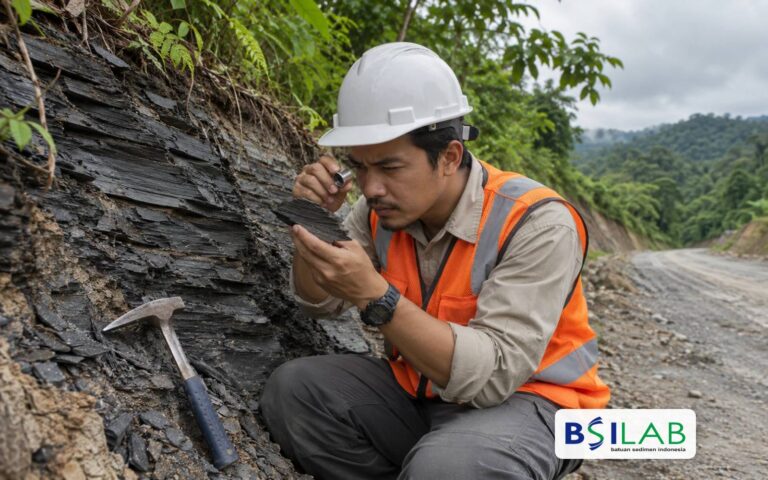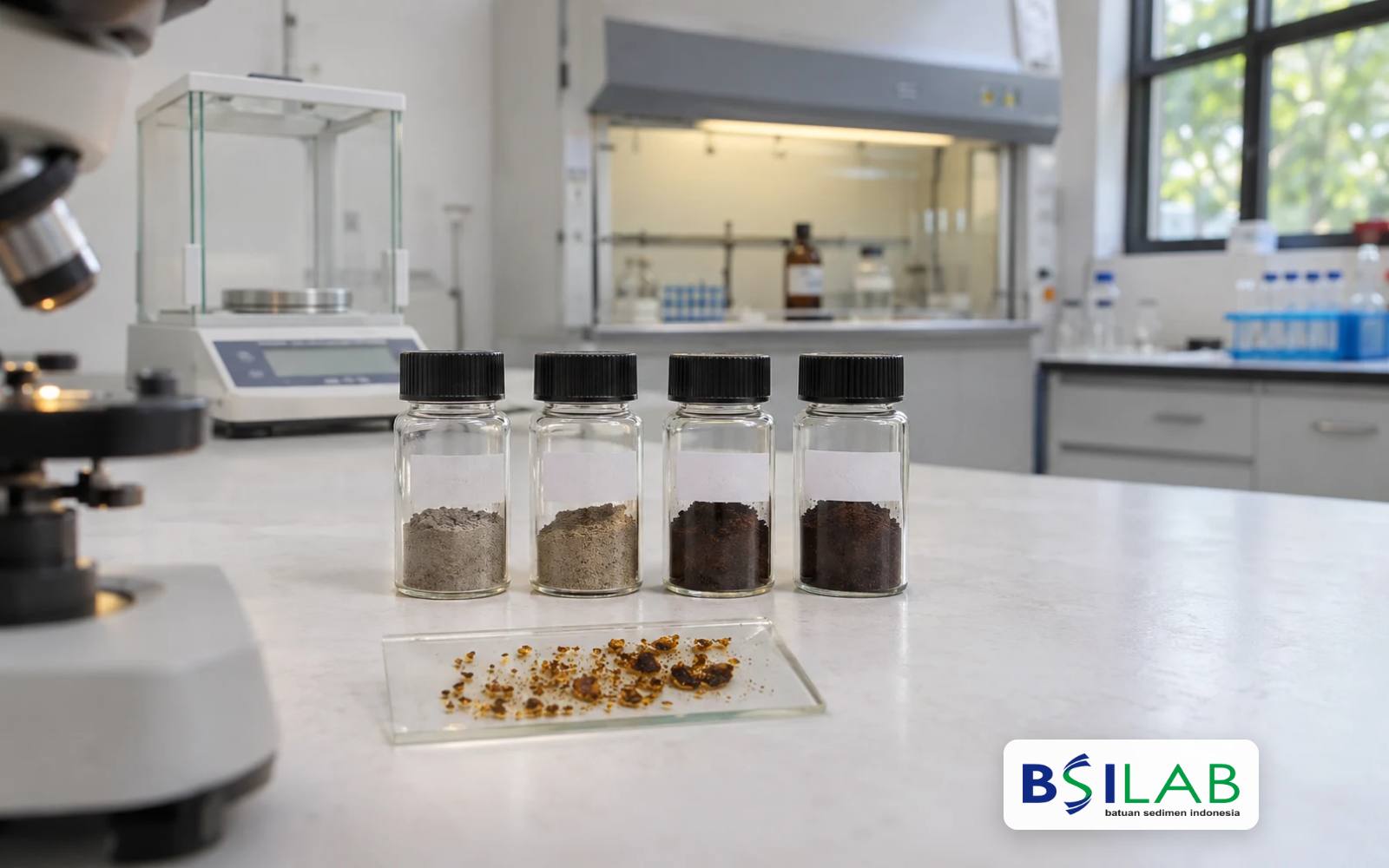
Kerogen are solid organic materials in sediment rocks not dissolving in organic solvent. This is what, if heated long enough, turns into oil and gas. Based on its perception and chemical composition, the kerogens are divided into type I, II, III, and IV. Kerogen types determine whether a parent rock tends to produce oil, gas, or barely produce anything.
- Type I — Lake algae, very hydrogen-rich, produces oil.
- Type II — marine plankton, hydrogen-rich, produces oil.
- Type III — Land plants, poor hydrogens, produce mainly gases.
- IV Type — Organic material oxidized or remodel, almost doesn't produce hydrocarbons.
Kerogen type comparison
| Types | The origin of organic material | Typical environment | H / C atom (start) | HI typical (mg HC / g TOC) | Product |
|---|---|---|---|---|---|
| I | Alga. Botrococcus), bacterial amorf material | Lake | > 1,5 | > 600 | Oil |
| II | Fitoplankton, zooplankton, marine bacteria | The ocean with the poor base of oxygen | ±1,2–1,5 | 300–600 | Oil (and gas at high height) |
| II / III | Mixed seas and land | Delta, sea near shore | ±1,0–1,2 | 200–300 | Oil and gas |
| III | High-level wood and plants | Delta, marsh, coal | < 1,0 | 50–200 | Gas, a little oil / condensate |
| IV | Organic material oxidized, charcoal, remodel | Various environments oxidized | < 0,6 | < 50 | Insignificant |
In addition to the four major types, known also I-S type, that's type II kerogen that's sulfur rich. It's starting to produce oil in lower chemistry than the regular II type.
Van Krevelen diagram and his rock- evals version.
Kerogen types are classically distinguished from Van Krevelen diagram, which is the atomic plot of H / C ratio against O / C of isolated kerogens. Because the isolation of the kerogen and the analysis of the elements takes time, in a daily practice used a fast version: pseudo-Van Kreveen diagram, which is plot Hydrogen Index (HI) against Oxygen Index (OI) of Rock-Eval Pyrolysis.
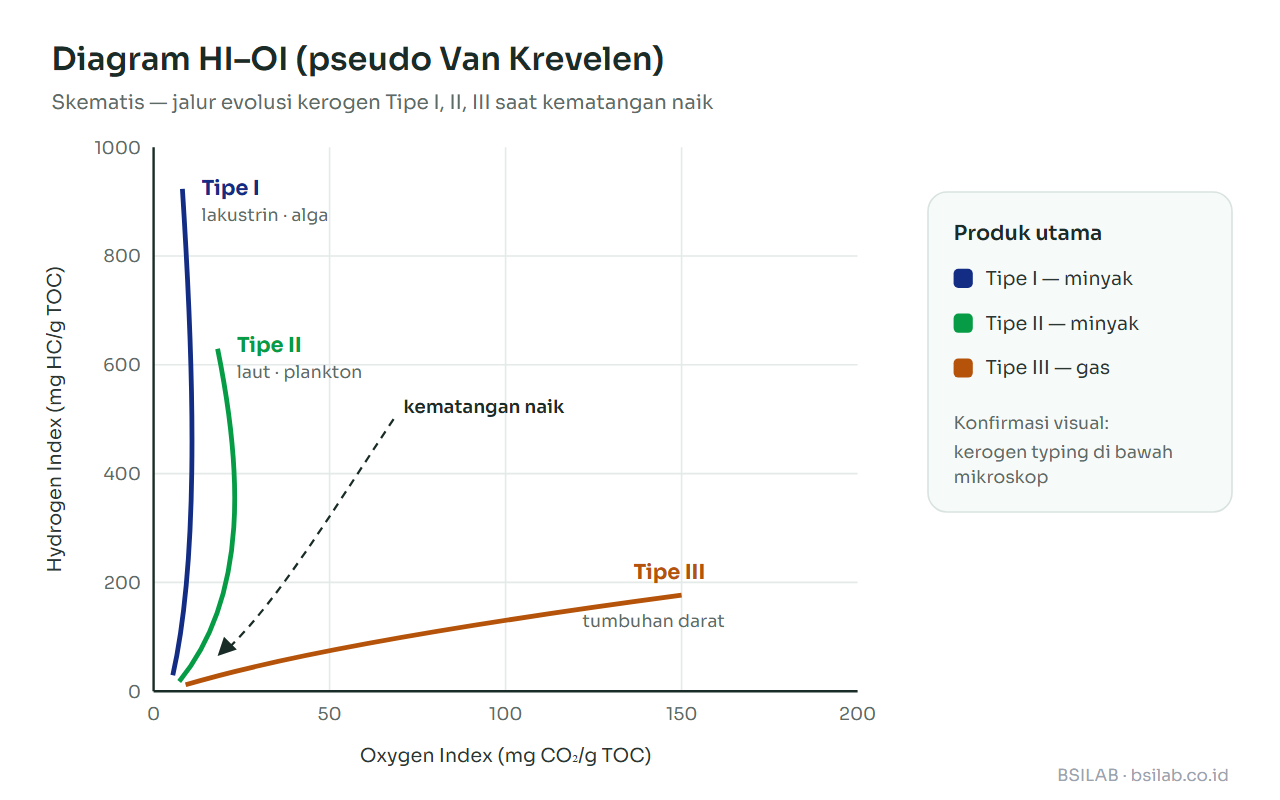
The most important thing to miss: HI down And as the rigidity is already converted into hydrocarbons. The mature L type stone could have low HI so it looked like type III. vitrinite reflection.
Visual typing kerogen
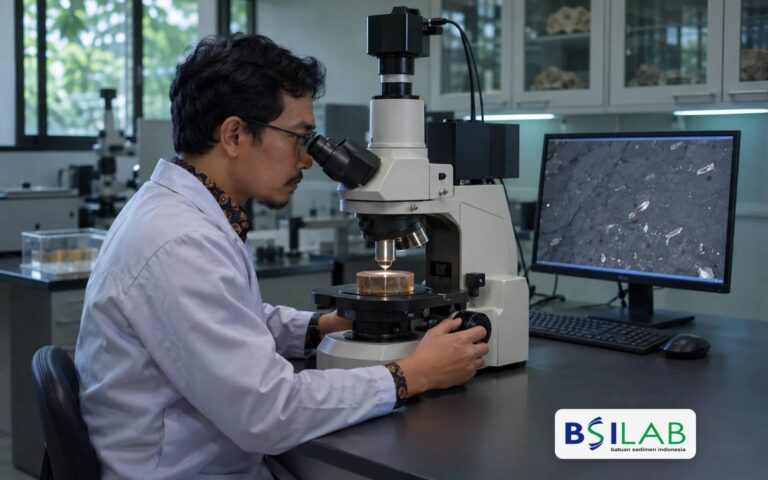
The second way is to observe the kerogen directly under the microscope. Component of organic material that looks like it Maseral, grouped into three:
- Liptinit (ecstasy), including alginites, spores, cuticula, and resin. Rich in hydrogen and tends to produce oil.
- Vitrinit, coming from the wood tissue. Tends to produce gas, and uses it to measure rigidity.
- Inertinit, organic material that's been oxidized or burned. Hardly produces hydrocarbons.
Besides, a lot of sea rocks contain Amorf organic material which no longer shows its origin structure. The combination of visual surveillance and RockEval data gives a more convincing type of kerogen than any of them.
Kerogen type and exploration in Indonesia
Tersier basins in Indonesia have diverse parent rocks. Geological literature records parent rock Akstrin (Lake) Which is kind of a Karogen type I, like a shale Formation in Central Sumatran Locate, as well as parent rock delta and stone It's dominated by kerogen type III and mixed with Il / III, like in Kutai Reception and in the Root Tablet Formation.
Need to make sure kerogen types of your parent rocks?
Kerogen typing and Rock- Eval Pyrolysis performed in@@
Questions often asked
What's a kerogen?
Kerogen is a dense organic material in sediment rock that doesn't dissolve in organic solvent. Kerogens come from the remains of organisms like algae, plankton, and plants, and it will turn into oil and gas when it heats up long enough for staging.
What's the difference between kerogen type I, II, and III?
The I type kerogen comes from the algae of the lake and is so rich in hydrogen that it produces oil. Type II comes from marine plankton and also produces oil. Type III comes from land plants, poorer hydrogen, and mainly producing gas.
What type of kerogen produces gas?
Kerogen III is most likely to produce gas. But all types of kerogens will produce gas at a very high level of rigidity, when the oil that was formed earlier is decomposed into gas.
How do I determine the type of kerogen?
Kerogen types are chemically defined by Rock-Eval Pyrolysis through the HI diagram against the OI, or with an element analysis on Van Krevelen diagrams, as well as visually by observing the masseres under the microscope. The best results are obtained by combining the two.
What's an IV type of kerogen?
The IV type of kerogen is an organic material that's already oxidized, burned, or hitched, so very poor hydrogen. It's practically not producing oil or gas even though TOC rocks are high enough.
Tissot, B.P. & Welte, D.H. (1984). Petroleum Formation and Occurence, 2nd ed. · Peters, K.E. & Cassa, M.R. (1994). Applied Source Rock Geochemistry. AAPG Memoir 60. · Tyson, R.V. Sementary Organic Matter. Chapman & Hall. · Doust, H. & Noble, R.A. (2008). Petroleum systems of Indonesia. Marine and Petroleum Geology 25.