Vitrinite reflection (% Ro) is the percentage of light reflected by particles vitrinit When you look under a microscope with imeric oil. The deeper and the longer the rocks are heated, the higher the vitine reflection, and these changes can't turn. Which is why% Ro becomes the most widely used "fossil thermometer" to determine thermal growth The mother rocks oil and gas.
- % Ro
- Ro's value is reported as an average of many vitrinite particles, as well as his histogram.
- Histogram is used to separate the original vitrinite from the itrinite remodel and collapse.
- % Ro should be read with Tmax Rock-Eval as cross-checking.
How to read% Ro
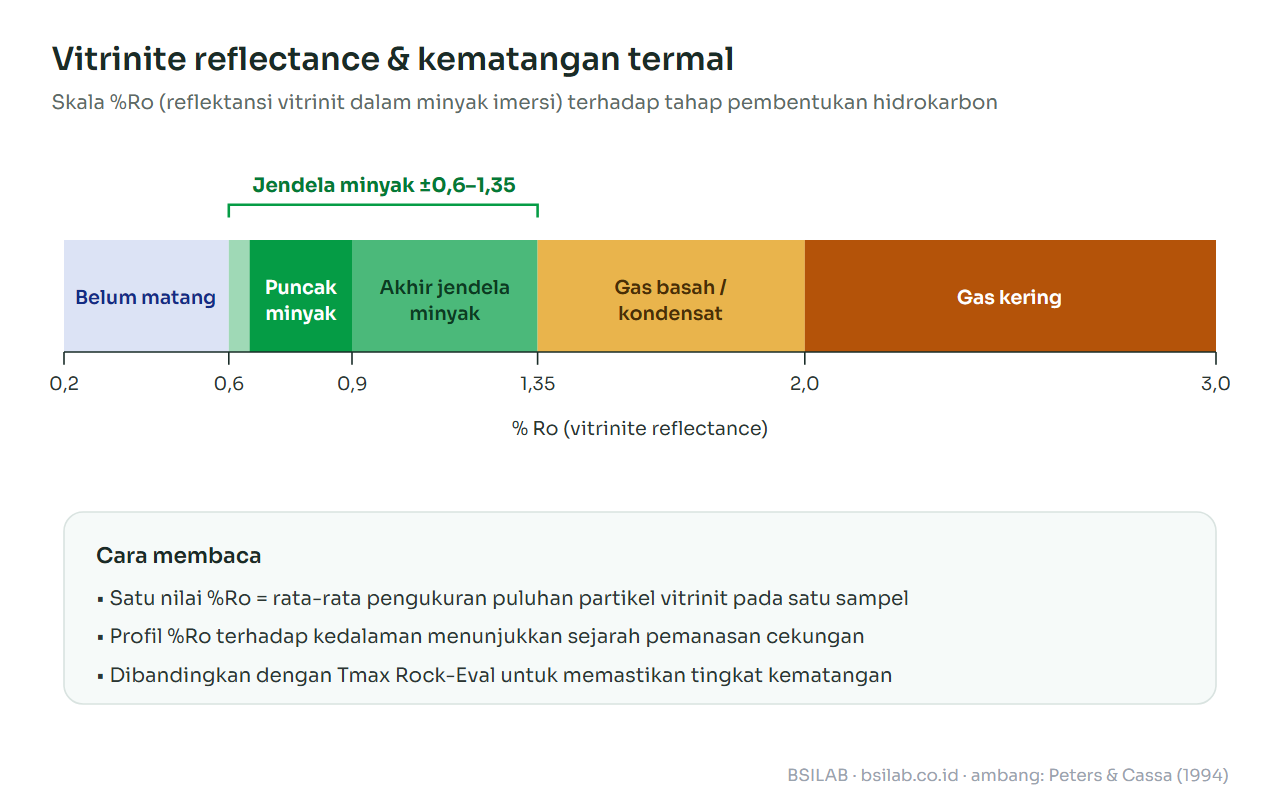
| % Ro | Stage of maturity | Hydrocarbons formed |
|---|---|---|
| < 0,6 | Uncooked (genesis) | Biogenic gas, a little early oil. |
| 0,6–0,65 | start date | Oil is starting to form |
| 0,65–0,9 | Top of the oil window | Maximum oil |
| 0,9–1,35 | Time of end | Light oil, rising gas |
| 1,35–2,0 | Early ripe pass | Wet gas and condensate |
| > 2,0 | It's going through. | Dry gas (methane) |
Range above summarized from Peters & Cassa (1994) and Tissot & Welte (1984). The oil window's initial limit can shift: the sulfur-rich kerogen (I-S type) starts producing oil at% Ro lower, while some new I type kerogen is active at% Ro is slightly higher.
How% Ro measured in lab
- Preparation — The rocks are crushed, printed in resin, then polished until the surface is very flat. For poor rock organic matter, kerogens can be concentrated first.
- Calibration — The microscope is calibrated with a standard reflective value known.
- Measurement — under the reflective light with the imersion oil on the wavelength of about 546 nm, the reflections are measured on many vitrinit particles one by one.
- Reporting — results presented as average value, default intersections, measurement counts, and histogram. The procedure for sediment rocks refers to ASTM D7708.
Reading histogram: original, remodel, or collapse?
Not all vitrinites in one sample represent the maturity of the rock. Histogram measurements help sort out the population:
- Original Vitrinit (indigenous) — The main population that represents the rigidity of those rocks.
- Vitrinit regrouped — It comes from older rocks that have been eroded, its value higher from the main population.
- Vitrinit collapse (caved) — On cutting samples, the shallows from the upper layers are blended in, the values lower.
Choosing the correct population is the main expertise in this analysis. The average range of any particle without a pipeline could be misleading.
Borders and ways of coping
- Vitrinit doesn't always exist. — Deep sea rocks, carbonates, and rocks that are older than Devon (before land plants) often don't contain vitrinites.
- vitrinit compression — On a very rich rock of kerogen type I or II, Ro's value can be read lower than actual maturity.
- Cross-check with Tmax — Tmax of Rock-Eval Pyrolysis could be converted into Ro's estimate. One of the equations used for type II kerogens is% Ro counts = 0,080 × Tmax 7.16 (Jarvie dkk., 2001). This equation is an approach and can be different for other type of kerogens.
Profile% Ro to depth
If% Ro is measured at some depth in one well, its value will form a trend that goes up down. This profile is used to determine oil window peak depth In the well, calibrating the historical model of hoarding and thermal basin, and detecting harmonization or rapture: if Ro's value jumps at a certain depth, possibly some layers have been eroded.
Need a record of parent rock?
Vitrinite reflections and Rock- Eval Pyrolysis performed in@@
Questions often asked
What's vitrinite reflection?
Vitrinite reflection is a percentage of light reflected by vitrinit particles under a microscope with imeric oil. Its value rises as it warms the rocks and it can't go back down, so it's used to measure thermal maturity of parent rock.
How much is Ro worth for an oil window?
The oil window is generally at% Ro about 0.6 to 1.35, with the peak of the oil formation at 0.65 to 0.9. Above 1.35 mother rocks mainly produce wet gas and condensate, and above 2.0 produces dried gas.
What's Ro and Tmax got to do with it?
Both measure thermal maturity. Tmax was acquired from RockEval Pyrolysis, while Ro was from microscope observations. For type II kerogen, Tmax can be converted to an approximate Ro with the Jarvie dkk equation. (2001), so both can check each other out.
Why is Ro accompanied by histogram?
One sample can contain the original vitrinit, the vitrinit a remodel of older rock, and vitrinit collapse from the upper layer. The histogram helps sort out the population so that the value that was reported actually represents rock maturity.
Can all the rocks be measured?
No. The measurement requires enough vitrinite particles. Carbon rocks, deep-sea rocks, and rocks that are older than Devon often don't contain vitrinites, so that they're rated with other parameters like Tmax.
Reference: ASTM D7708 — Standard Test Method for Microsoft Determination of the Reflection of Vitrinite Dissepend in Sementary Rocks. · Taylor, G.H. Doc. Organic Religion. Gebrüder Borntraeger. · Peters, K.E. & Cassa, M.R. (1994). AAPG Memoir 60. · Jarvie, D.M. Dkk. Oil and shale gas from the Barnett Shale. AAPG Annual Meeting. · Tissot, B.P. & Welte, D.H. (1984). Petroleum Formation and Occurence.