


Kerogen Typing
Popping Kerogen Service
Kerogen Typing identify kind organic material inside parent rock—whether it's from the algae of lakes, marine plankton, or land plants. Kerogen types determine whether rocks tend to produce oil or gas, so this analysis completes the number TOC and Rock-Eval.
Four types of kerogens
| Types | The origin of organic material | The dominant component | Main product |
|---|---|---|---|
| Type I | Lake algae. | Alginit, organic material amorf is hydrogen-rich | Oil |
| Type II | Plankton & marine bacteria | Amorf organic matter, lipstick | Oil (and gas) |
| Type III | High-level land plant | Vitrinit | Gas |
| IV Type | The organic material is oxidized or recycled | Inertinit | Practically not potentially |
Two ways to determine the kerogen type
1. Chemically. — Rock-Eval
Hydrogen Index and Oxygen Index from Rock-Eval Pyrolysis plotted on the HI- OI diagram. The hydrogen-rich kerogen is at the top, whereas the oxygen-rich kerogen is at the bottom right.
2. Visually — microscope.
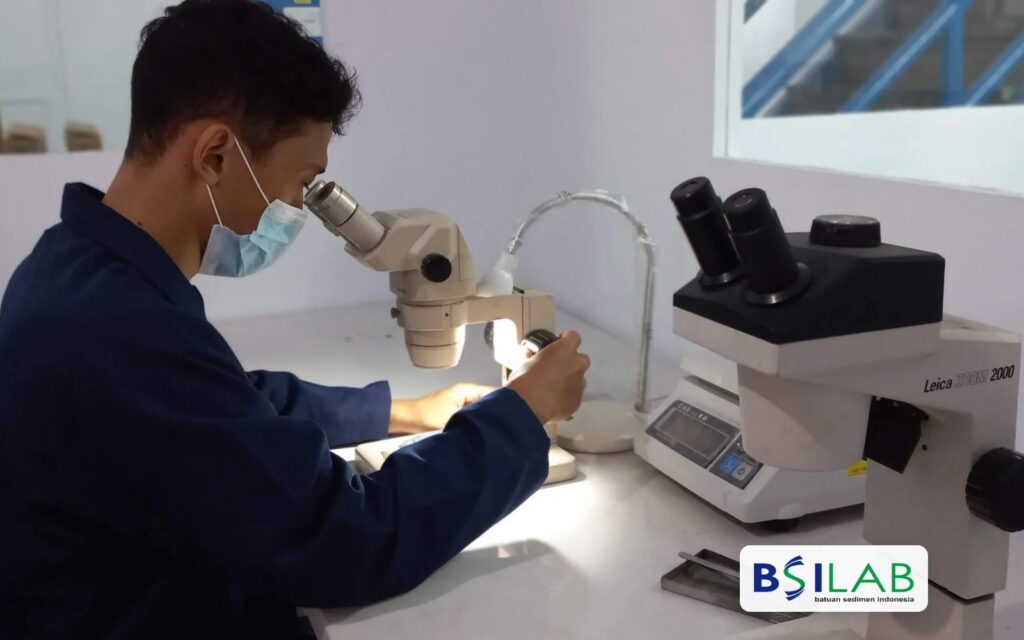
Kerogens separated from the mineral rock with acid solution, then observed under a microscope of light transmission and fluorescence. Analysts identify the organic proportion of amorf, liptinite, vitrinite, and inertinite, and the cerogen color as an adhesive parameter to later get the thermal Alteration Index or the Thermal Alteration Scale (TAS).
When does the typing kerogen need?
- Whether parent rocks tend to produce oil or gas in block evaluations and basin studies.
- Confirm ambiguous HII-OI RockEval results.
- Installing a petroleum system model that requires a kind of kerogen as input.
The geochemical sequence of parent rocks in BSILAB
This whole stage is being done in BSILAB labs: TOC → Rock-Eval Pacikerogen typing & vitrinite reflection Extracting, SARA, GC & GC-MS.
Need kerogen typing?
Consult the number of samples and packages of master rock analysis (TOC, Rock-Eval, kerogen typing, vitrinite reflection) with the BSILAB team.
Questions often asked
What's a typing kerogen?
Kerogen typing is an analysis to determine the type of unending organic material in parent rock, which is Type I, II, III, or IV.
What's the difference between Kerogen Type I, II, and III?
Kerogen Type I comes from the algae of the lake and is so rich in hydrogen that it tends to produce oil. Type II comes from marine plankton and also produces oil. Type III comes from land plants, more oxygen-rich, and tends to produce gas.
Is the kerogen typing enough with the Rock- Eval alone?
Rock-Eval gives indications of a kind of kerogen through Hydrogen Index and Oxygen Index, but its value is also affected by rigidity and rock matrix. Kerogen observations below the microscope are used to confirm, especially when the HIOI result is in the intertype transition area.
Is that a Van Krevelen diagram?
Van Krevelen's diagram originally plots the atomic ratio of H / C against O / C to group the kerogens. In laboratory practice, the version of pseudo Van Krevelen uses Hydrogen Index and Oxygen Index from Rock@@
Read too: Kerogen Type I, II, III, and IV · Judging by Parent Stone (Rock Source)
Tissot, B.P. & Welte, D.H. (1984). Petroleum Formation and Occurence. Springer. · Peters, K.E. & Cassa, M.R. (1994). Applied Source Rock Geochemistry. AAPG Memoir 60.
Explore more solutions.
Frequently Asked Questions (FAQ)
Here are some of the general questions that are often asked.
We provide lab analysis services on Geoscics covering Geochemistry, Biostratigraphy, Ethology, Core Analysis, and Interwell Tracer.
We're prepared to support an international project with global-recognized standard lab and reporting.
We focus on the oil and gas industry, and geothermal project.
Duration relies on service types and samples, generally between 1 -4 weeks.
We're implementing standard analysis and quality procedures according to industrial regulation migas and geometry.
Clients can send samples directly to our lab in South Attack with standard packaging guide.
All results are delivered in digital format and print with complete data and technical interpretation.
You can call us via email info.bsi.lab@bsilab.co.id or phone +62 813-1300-2541.