


Rock-Eval Pyrolysis Warming rock samples gradually without oxygen to measure how much hydrocarbons are already there and that can still be produced by organic materials. From one time analysis, you get a picture The potential, the type of kerogen, and the level of maturity. The mother rocks. BSILAB provides Rock-Eval Pyrolysis as part of a series of geochemical analysis of parent rocks, usually mixed with TOC analysis. Analisis Rock-Eval dikerjakan in-house di laboratorium geokimia BSILAB.
Generated parameters
| Parameter | Units | Meaning |
|---|---|---|
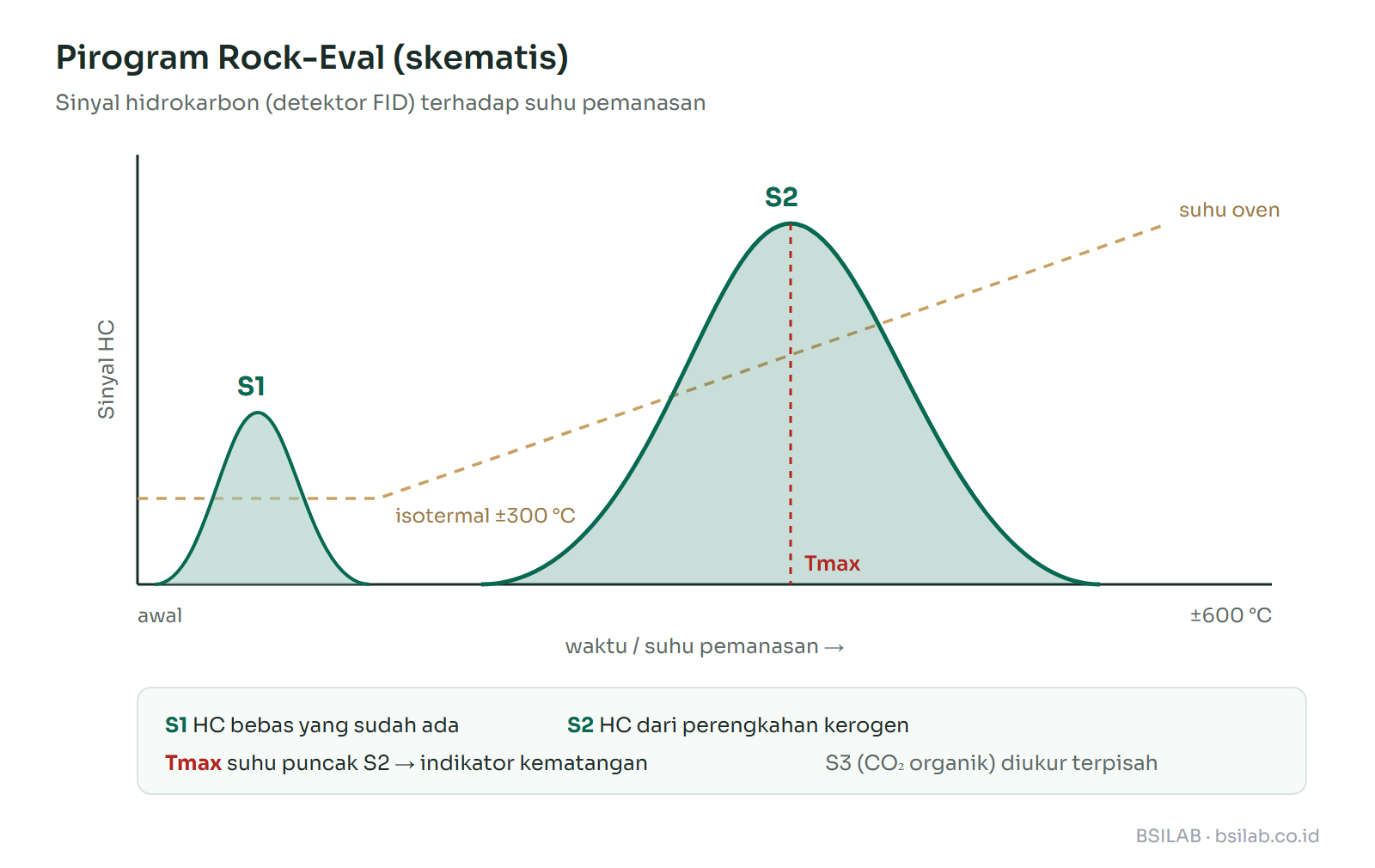
| S1 | mg HC / g rocks | Free hydrocarbons that already exist inside rocks. |
| S2 | mg HC / g rocks | Hydrocarbons are produced from the grazing of the kerogens. — potential size remaining parent rock |
| S3 | mg CO2/ g rocks | CO2 organic material. — It deals with the content of kerogen oxygen |
| Tmax | ° C | Temperature at the height of S2 reached — thermal alignment |
| HI (Hydrogen Index) | mg HC / g TOC | S2 × 100 / TOC — kerogen type marker |
| OI (Oxygen Index) | mg CO2/ g TOC | S3 × 100 / TOC |
| IM (Production Index) | — | S1 / (S1 + S2) — How much hydrocarbons are already formed |
How to read the RockEval results
1. The potential of hydrocarbons (S2)
| S2 (mg HC / g rocks) | Potential |
|---|---|
| < 2,5 | Bad |
| 2,5 – 5 | Medium |
| 5 – 10 | Good |
| 10 – 20 | Very good |
| > 20 | Special |
2. Jenis kerogen (HI) — konfirmasi dengan Kerogen typing
| HI (mg HC / g TOC) | Kerogen type | Main product |
|---|---|---|
| > 600 | Type I | Oil (generally acurine / alga) |
| 300 – 600 | Type II | Oil (generally ocean) |
| 200 – 300 | Type II / III | Oil and gas |
| 50 – 200 | Type III | Gas. |
| < 50 | IV Type | Not potentially |
3. Stability Level (Tmax and PI)
| Stage of maturity | Tmax (° C) | IM |
|---|---|---|
| Uncooked (immune) | < 435 | < 0,10 |
| Start oil window | 435 – 445 | 0,10 – 0,15 |
| Top of the oil window | 445 – 450 | 0,25 – 0,40 |
| End of oil window | 450 – 470 | > 0,40 |
| Premature (postmature / gas) | > 470 | — |
Ambang interpretasi: Peters & Cassa (1994), AAPG Memoir 60. Nilai Tmax dapat dipengaruhi jenis kerogen dan kontaminasi; interpretasi kematangan sebaiknya dikonfirmasi dengan vitrinite reflectance.
When is RockEval needed?
- Judging by the potential and kind of parent rock in the exploration block evaluation or basin study.
- Whether the parent rocks have entered the oil or gas window.
- Supports modeling of petroleum and modeling systems.
- Filter samples before more expensive analysis like GC-MS biomarker.
How to send samples
- Consult — Submit the number and type of sample as well as the purpose of study.
- Offers — BSILAB team informs the required sample count, analysis package (TOC + Rock-Eval), cost, and estimate of time.
- Sample Delivery fully labeled (well / location, depth, date) with sample list.
- Digital report contains all Rock-Eval parameters per sample, ready for HI-Tmax plots and interpretations.
Consult TOC + Rock-Eval packages
The BSILAB team helped determine the number of samples and the order of the most efficient analysis for the study of your parent rocks.
Questions often asked
What's a Rock- Eval Pyrolysis?
Rock-Eval Pyrolysis is a geochemical analysis that heats up rock samples gradually in an atmosphere without oxygen. The results are S1, S2, S3, and Tmax parameters that indicate the potential for hydrocarbons, the type of kerogen, and the thermal rate of a parent rock.
What's S1, S2, and Tmax?
S1 is a free hydrocarbon that's already on the rocks. S2 is hydrocarbons produced when the kerogen is heated, so it shows the potential of remaining rock master. Tmax is the temperature at the height of S2 reached and used as a thermal coordinates.
Does RockEval have to be accompanied by TOC analysis?
Yeah, almost always. Hydrogen Index and Oxygen Index are calculated by sharing S2 and S3 against TOC.
How many Tmax indicate the rocks are ripe?
In general, Tmax below 435 ° C indicates uncooked rock, 435-470 ° C is in the oil-forming window, and above 470 ° C is already entering the gas phase. This value should be confirmed with vitrinite reflection.
Espiralié, J. dkk. Méthode rapide de caractérisation des roches mères. Revue de I'IFP 32. · Peters, K.E. & Cassa, M.R. (1994). Applied Source Rock Geochemistry. AAPG Memoir 60.


