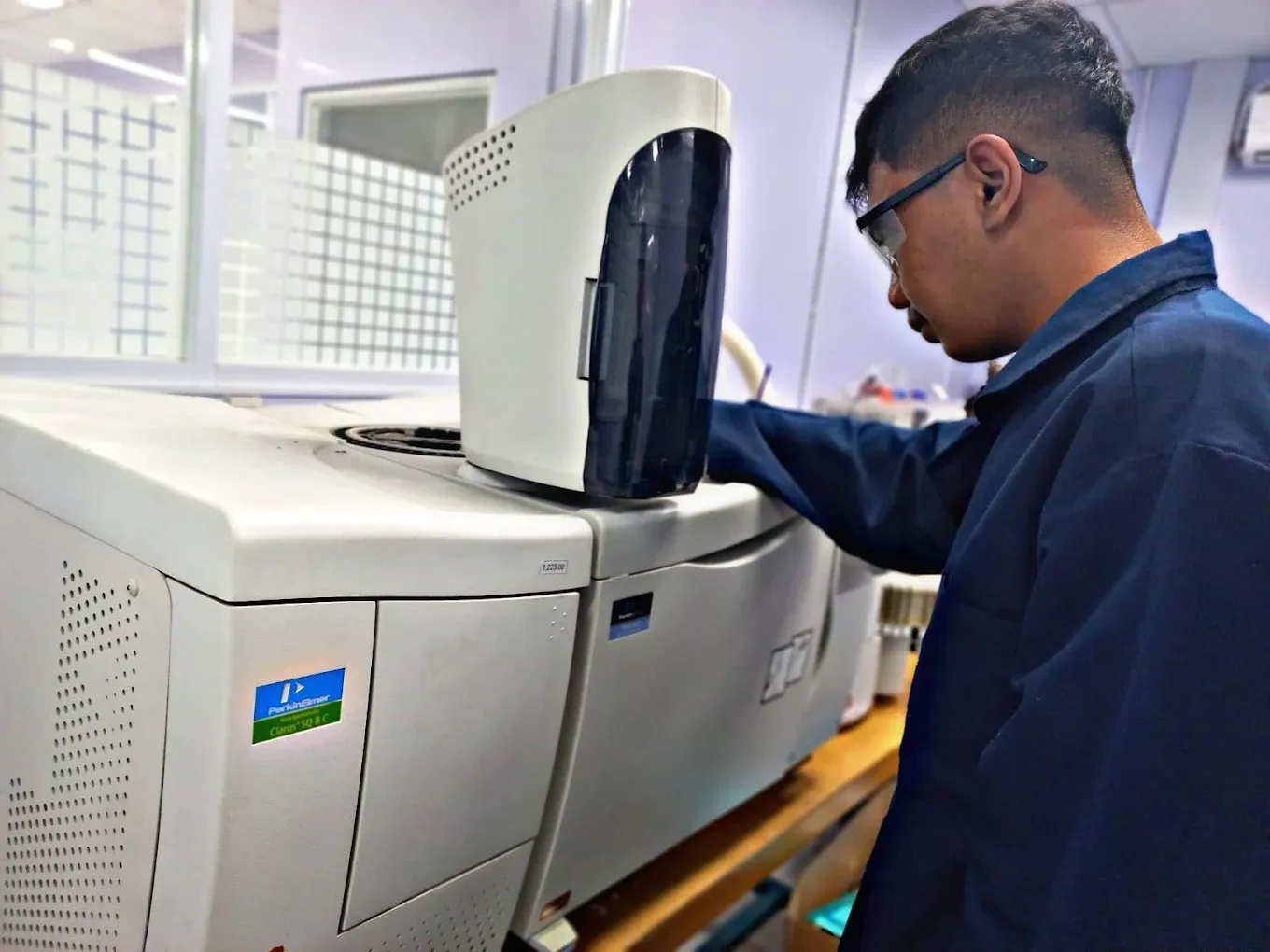
Two wells in the same basin produce oil. Is the oil from the same mother rock? A question like this is answered by biomarker—fossil molecules in the oil which is analyzed using GC-MS (Chromatography gas -Mass Spectrometry). This article explains what biomarkers are, how they read them, the most common parameters, and how they help with exploration decisions.
What's a biomarker?
Biomarker is an organic compound in petroleum, bitumen, or rocks whose molecular framework still resembles molecules of origin in living organisms. For example:
- Sterana — The derivative of the sterol of the membrane of the cell eukarmotor organisms like algae and plants.
- Hopana — It's a homanioid derivative of a bacterial cell membrane.
- Pristana and fitana — The derivative of the chlorophyil fitol chain.
- Oleanane — The derivative of a typical flowering plant compound.
Because the structure has been relatively stable for millions of years, the biomarker pattern becomes kind of fingerprint It holds information about the source organisms, the detachment environment, and the history of its parent rock warming.
From sample to chromatogram
Oil or rock extract is not directly inserted into GC-MS. Generally samples are extracted, then separated into parts of saturate, aromatic, resin, and aspalten. The saturate and aromatic fraction was later analyzed with GC to see the profile of nalkana, and with GC-MS to read the biomarker.
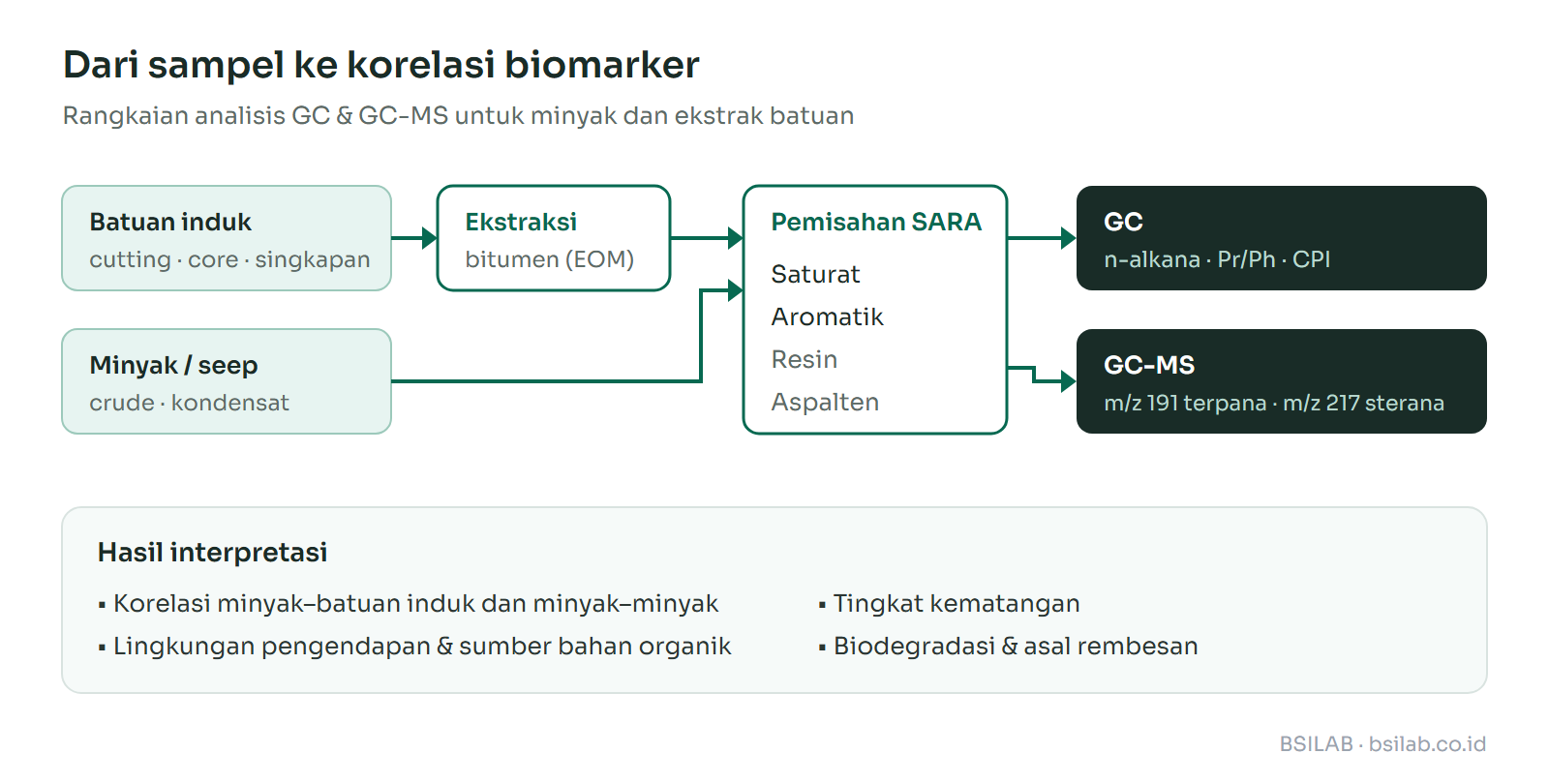
Reading m / z 191 and m / z 217
The spectrometer mass breaks every molecule into fragments. By monitoring certain fragments, analysts could "filter" one group of thousands of other compounds:
| monitored Ion | Compounds group | Information Sample |
|---|---|---|
| m / z 191 | Roosted: hopang, tricyclic floored, oleanane, gammacerane | Insert bacteria, flowering plants, licitas / stratification, rigority (Ts / Tm) |
| m / z 217 | Sterana C27, C28, C29 | The source of sea algae versus land plants, ridiness (isomerization 20S / 20R) |
The most frequently used biomarker parameter
| Parameter | General indications |
|---|---|
| Pristana / Fitana (Pr / Ph) | < |
| Distribution of sterana C27-C28-C29 | C27 dominant tends to algae; C29 dominant tends to grow land (with exception) |
| Oleanane Index | Flowery Contributions; common in late Chalk-Tersier oil, including many delta oil in Southeast Asia |
| Gammacerane index | Strativized water columns, often associated with high-water or lakes. |
| Ts / Tm | It goes up as it grows, but it also affects the lithology of parent rock. |
| Sterana C29 20S / (20S + 20R) | Wealth; reached equilibrium around 0.52-0.55 |
| The disappearance, the appearance of 25- norhopana. | Biodegradation by bacteria in the reservoir |
Read too: Geochemical Analysis Choice · Judging by Parent Stone (Rock Source)
Summary of indications follows Peters, Walters & Moldowan (2005), The Biomarker Guide.
An example of application in exploration
1. Oil correlation - parent rocks
The oil biomarker from the well compared to the biomarker extracted some of the parent rocks. The motherland whose pattern is most likely to be the primary source candidate. It's important to map the "kitchen" of hydrocarbons and the direction of the migration.
2. Oil correlation - oil
If two adjacent fields produce oil with different fingerprints, there might be more than one petroleum system in that basin.—valuable information to determine his next target.
3. Read the intercept environment
In Indonesia, for example, a lot of oil in Sumatra is derived from Tersier-aged acidic mother rock, while a lot of oil in the East Kalimantan delta basin is associated with organic land plants that are rich in oleanane. Biomarker patterns help distinguish the two.
Four. Tracking the origin of the seeker or the spill
Biomarker fingerprints are relatively resistant to light layering, so that the seething on the surface or oil spill can be compared to a sample of reference to tracing its source.
When are the samples worth analyzing GC-MS?
GC-MS is more expensive and longer than geochemical screenings. Therefore the rock samples are usually chosen gradually: TOC → Rock-Eval Extractions and SARA GC trust GC-MS for key samples. Oil samples and seedlings usually go straight into the fraction stage.
Need an oil-mother correlation?
BSILAB provides a series of extraction, separation SARA, GC, and GC-MS biomarker.
Questions often asked
What's an oil biomarker?
The oil biomarker is a fossil molecule like sterana, homopana, and the isophenoid structure still reflects its origin organism. The pattern is analyzed with GC-MS to know the source of organic matter, the environment of the host rock detection, the level of rigidity, and the biodegradation of oil.
What does oil and mother correlation do?
Oil correlation and parent rock are done to figure out which of these stones produce oil in a field. This information helps map the petroleum system, estimate the direction of hydrocarbon migration, and choose the next target of exploration at a lower risk.
What does pristana / fitana ratio mean?
Pristana ratio of fitana (Pr / Ph) used as a hint of oxygen conditions when organic matter was deposited. The values below 1 tend to show an anoxic environment, whereas the above 3 values tend to show land organic matter in an octical state. This ratio is also affected by maturity.
Is GC enough without GC-MS?
GC is enough to view the profile of n-alkana, pristana / fitana ratio, and the signs of biodegradation quickly. But for the oil correlation of parent rocks and the determination of convincing detachment environments, the sterana biomarker and the floored GC-MS are almost always necessary.
Peters, K.E., Walters, C.C. & Moldowan, J.M. (2005). The Biomarker Guide, the 2nd edition. Cambridge University Press. · Tissot, B.P. & Welte, D.H. (1984). Petroleum Formation and Occurence. Springer.